Quotessence
Home / Quotes / Quote by Thomas Jefferson

Quote by Thomas Jefferson

“Altho' I rarely waste time in reading on theological subjects, as mangled by our Pseudo-Christians, yet I can readily suppose Basanistos may be amusing. Ridicule is the only weapon which can be used against unintelligible propositions. Ideas must be distinct before reason can act upon them; and no man ever had a distinct idea of the trinity. It is mere Abracadabra of the mountebanks calling themselves the priests of Jesus. If it could be understood it would not answer their purpose. Their security is in their faculty of shedding darkness, like the scuttlefish, thro' the element in which they move, and making it impenetrable to the eye of a pursuing enemy, and there they will skulk. [Letter to Francis Adrian Van der Kemp on 30 July 1810 denouncing the Christian doctrine of the Trinity]”

Quote by Thomas Jefferson

Work

Letters of Thomas Jefferson

Browse quotes and source details for this work. more

Author
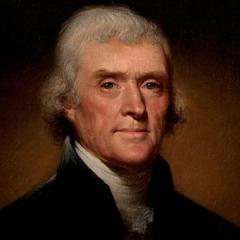
Thomas Jefferson
Thomas Jefferson

Thomas Jefferson was the third President of the United States, a distinguished politician, philosopher, architect, and scientist. He was born on April 13, 1743, and died on July 4, 1826. Jefferson advocated for democracy and freedom in politics and was one of the main authors of the Declaration of Independence. His political ideas had a profound impact on the founding and development of the United States. more

You May Also Like

“God's high freedom in Jesus Christ is His freedom for LOVE. The divine capacity which operates and exhibits itself in that superiority and subordination is manifestly also God's capacity to bend downwards, to attach Himself to another and this other to Himself, to be together with him. This takes place in that irreversible sequence, but in it is completely real. In that sequence there arises and continues in Jesus Christ the highest communion of God with man. God's deity is thus no prison in which He can exist only in and for Himself. It is rather His freedom to be in and for Himself but also with and for us, to assert but also to sacrifice Himself, to be wholly exalted but also completely humble, not only almighty but also almighty mercy, not only Lord but also servant, not only judge but also Himself the judged, not only man's eternal king but also his brother in time. And all that without in the slightest forfeiting His deity! All that, rather, in the highest proof and proclamation of His deity! He who DOES and manifestly CAN do all that, He and no other is the living God.”

“The divine persons do not assert themselves, but one bears witness to another. It is for this reason that St. John of Damascus said that 'the Son is the image of the Father, and the Spirit the image of the Son.' It follows that the third person of the Trinity is the only one not having his image in another person. The Holy Spirit, as person, remains unmanifested, hidden, concealing himself in his very appearing... The Holy Spirit is the sovereign unction upon the Christ and upon all the Christians called to reign with him in the Age to come. It is then that this divine person, now unknown, not having his image in another member of the Trinity, will manifest himself in deified persons: for the multitude of the saints will be his image.”

“Christians do not believe that there is one God and three Gods. Nor do we believe that God is one person and three persons. That would clearly be contradictory and therefore logically impossible. Rather, the doctrine of the Trinity is that there is one God who eternally exists as three distinct persons. We believe that The Father, The Son, and The Holy Spirit are each individual persons in their own right, but they all share the same divine essence. Saying that "God is one being who consists of three persons" is no more contradictory than saying that "There's one triangle that consists of three corners”

“The Ontological Argument shows us that in order for God to be maximally great, He must be morally perfect. Being all loving is a part of good morality, but before the creation of humans, God had no one to love, so how could He be loving? He couldn’t be. If He isn’t loving, He isn’t morally perfect, and if He isn’t morally perfect, He isn’t maximally great. How do we resolve this? The doctrine of The Trinity provides the answer. God needs to be a Trinity in order to be love. For love requires three things: 1; a lover 2; a beloved 3; a relationship between them.”