Quotessence
Home / Quotes / Quote by Gustave Flaubert

Quote by Gustave Flaubert

“Deep in her soul, however, she was waiting for something to happen. Like a sailor in distress, she would gaze out over the solitude of her life with desperate eyes, seeking some white sail in the mists of the far-off horizon. She did not know what this chance event would be, what wind would drive it to her, what shore it would carry her to, whether it was a longboat or a three-decked vessel, loaded with anguish or filled with happiness up to the portholes. But each morning, when she awoke, she hoped it would arrive that day, and she would listen to every sound, spring to her feet, feel surprised that it had not come; then at sunset, always more sorrowful, she would wish the next day were already there.”

Quote by Gustave Flaubert

Work

madame bovary

Gustave Flaubert's Madame Bovary is a seminal work of 19th-century French literature. The novel follows the life of Emma Bovary, a woman who is discontent with her provincial life and marries Charles Bovary, a dull and unambitious country doctor. Emma's dissatisfaction leads her to seek fulfillment through romantic escapades and extramarital affairs, ultimately leading to disaster. Flaubert's meticulous attention to detail and his exploration of themes such as social class, materialism, and the human condition have made this novel a classic of world literature. more

Author

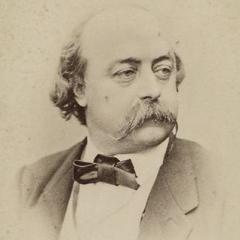
Gustave Flaubert
Gustave Flaubert

Gustave Flaubert, born on December 12, 1821 and died on May 8, 1880, was a prominent French writer of the 19th century. Known for his exquisite literary skills and profound psychological portrayals, Flaubert is best remembered for his masterpiece 'Madame Bovary'. more

You May Also Like

“If you disagree with something, it's easier to say 'you suck' than to figure out and explain exactly what you disagree with. You're also safe that way from refutation. In this respect trolling is a lot like graffiti. Graffiti happens at the intersection of ambition and incompetence: people want to make their mark on the world, but have no other way to do it than literally making a mark on the world.”

“Oh, noble child, everything is severing the mind. As for the mind, it is severing pride. There is nothing whatsoever that is not included in pride. If one simply understands that it is merely the production of pride, then, for example, one is like a thief in an empty house: by simply recognizing [the situation], grasping is impossible. Having correctly understood, there is no practice with an intentional objective. Because it crushes any hesitations (mi phod), it is explained as Chöd.”

“When I was small my mother tried to teach me the colors. "Blue," she said, pointing to the sky. And "blue" again, the second time pointing to the water. She told me I shook my head because I could see that sky blue was not always the same as water blue. It took me a long time-until I lived in Oria- to use the same word for all the shades of a color... Love has different shades. Like the way I loved Cassia when I thought she'd never love me. The way I loved her on The Hill. The way I love her now that she came into the canyon for me. It's different. Deeper. I thought I loved her and wanted her before, but as we walk through the canyon together I realize this could be more than a new shade. A whole new color.”

“He stopped the flyers And by his rare example made the coward Turn terror into sport. As weeds before A vessel under sail, so men obeyed And fell below his stem. His sword, Death's stamp, Where it did mark, it took; from face to foot He was a thing of blood, whose every motion Was timed with dying cries. Alone he entered The mortal gate o' th' city, which he painted With shunless destiny; aidless came off And with a sudden reinforcement struck Corioles like a planet. Now all's his, When by and by the dim of war gan pierce His ready sense; then straight his doubled spirit Requickened what in flesh was fatigate, And to the battle came he, where he did Run reeking o'er the lives of men as if 'Twere a perpetual spoil; and till we called Both field and city ours, he never stood To ease his breast with panting.”