Quotessence
Home / Quotes / Quote by Sergei Lukyanenko

Quote by Sergei Lukyanenko

“Do you have a truth of your own, Anton? Tell me, do you? Are you certain of it? Then believe it, not in my truth, not in Geser's. Believe in it and fight for it. If you have enough courage. If the idea doesn't make you shudder. What's bad about Dark freedom is not just that it's freedom from others. That's another explanation for little children. Dark freedom is first and foremost freedom from yourself, from your own conscience and your own soul. The moment you can't feel any pain in your chest—call for help. Only by then it'll be too late”

Quote by Sergei Lukyanenko

Work

Night Watch

In this gripping narrative, the protagonist navigates a complex world where the supernatural and the human coexist, facing moral dilemmas and the struggle for power. The story delves into themes of loyalty, betrayal, and the human condition, all while the protagonist grapples with the responsibilities of his role in the Night Watch. more

Author

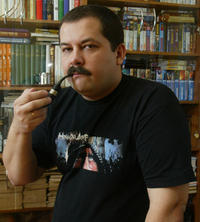
Sergei Lukyanenko
Sergei Lukyanenko

Sergei Lukyanenko is a celebrated Russian author, recognized for his science fiction and fantasy novels. Born on April 11, 1968, he has achieved international acclaim for his works, especially the Night Watch series. more

You May Also Like

“Gjerji raises his hand. In English he says, "I like to tell in the words of a great American philosopher what freedom is." "Say it in your language to your peers," I urge. Gyerji makes his statement. The class grows silent and thoughtful; there is much nodding. Twain perhaps? Emerson? Diana sidles up and whispers in my ear. "He says to them that freedom is a word when nothing is anymore able to be losed." Janis Joplin, de-syntaxed.”

“The anarch differs from the anarchist in that he has a very pronounced sense of the rules. Insofar as and to the extent that he observes them, he feels exempt from thinking. This is consistent with normal behavior: everyone who boards a train rolls over bridges and through tunnels that engineers have devised for him and on which a hundred thousand hands have labored. This does not darken the passenger’s mood; settling in comfortably, he buries himself in his newspaper, has breakfast, or thinks about his business. Likewise, the anarch – except that he always remains aware of that relationship, never losing sight of his main theme, freedom, that which also flies outside, past hill and dale. He can get away at any time, not just from the train, but also from any demand made on him by state, society, or church, and also from existence. He is free to donate existence to Being, not for any pressing reason but just as he likes, whether out of exuberance or out of boredom. Why do so many people strive for the career of petty functionary? No doubt because they have a sensible notion of happiness. They know the rules and their taboos. Time flows by nonchalantly. You are already half-way to Tibet. Plus the security. No state can do without minor officials, no matter how high the waves may surge. Of course, you have to keep a low profile.”

“Call no man lucky until he is dead, but there have been moment of rare satisfaction in the often random and fragmented life of the radical freelance scribbler. I have lived to see Ronald Reagan called “a useful idiot for Kremlin propaganda” by his former idolators; to see the General Secretary of the Communist Party of the Soviet Union regarded with fear and suspicion by the Communist Party of Czechoslovakia (which blacked out an interview with Miloš Forman broadcast live on Moscow TV); to see Mao Zedong relegated like a despot of antiquity. I have also had the extraordinary pleasure of revisiting countries—Greece, Spain, Zimbabwe, and others—that were dictatorships or colonies when first I saw them. Other mini-Reichs have melted like dew, often bringing exiled and imprisoned friends blinking modestly and honorably into the glare. E pur si muove—it still moves, all right.”