Quotessence
Home / Quotes / Quote by Thomas Carlyle

Quote by Thomas Carlyle

“Know thyself': long enough has that poor 'self' of thine tormented thee; thou wilt never get to 'know' it, I believe! Think it not thy business, this knowing of thyself; thou art an unknowable individual: know what thou canst work at; and work at it, like a Hercules! That will be thy better plan.”

Quote by Thomas Carlyle

Author
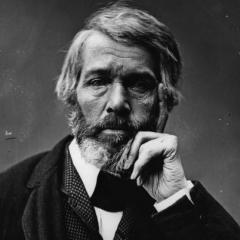
Thomas Carlyle
Thomas Carlyle

Thomas Carlyle, born on December 4, 1795, and died on February 5, 1881, was a prominent Scottish philosopher, historian, and writer. His works are known for their profound social criticism and unique literary style, which had a significant impact on 19th-century British literature and thought. more

You May Also Like

“Carlyle's genius was many-sided. He touched and ennobled the national life at all points. He lifted a whole generation of young men out of the stagnating atmosphere of materialism and dead orthodoxy into the region of the ideal. With the Master of Balliol, we believe that 'no English writer has done more to elevate and purify our ideas of life and to make us conscious that the things of the spirit are real, and that in the last resort there is no other reality.”

“In employing the long sentence the inexperienced writer should not strain after the heavy, ponderous type. Johnson and Carlyle used such a type, but remember, an ordinary mortal cannot wield the sledge hammer of a giant. Johnson and Carlyle were intellectual giants and few can hope to stand on the same literary pedestal.”

“The wind blows east, the wind blows west, And the frost falls and the rain: A weary heart went thankful to rest, And must rise to toil again, ‘gain, And must rise to toil again. The wind blows east, the wind blows west, And there comes good luck and bad; The thriftiest man is the cheerfulest; ’Tis a thriftless thing to be sad, sad, ’Tis a thriftless thing to be sad. The wind blows east, the wind blows west; Ye shall know a tree by its fruit: This world, they say, is worst to the best;— But a dastard has evil to boot, boot, But a dastard has evil to boot. The wind blows east, the wind blows west; What skills it to mourn or to talk? A journey I have, and far ere I rest; I must bundle my wallets and walk, walk, I must bundle my wallets and walk. The wind does blow as it lists alway; Canst thou change this world to thy mind? The world will wander its own wise way; I also will wander mine, mine, I also will wander mine.”

“Buchan's less polemical evaluation of 1932, with its focus on the historical context of Scott's writing, recognised the author's virtues, but did little to change the narrative of his limitations. Beside the reminder that the author 'knew his native land as no Scotsman had ever known it before', the insight that Scott's popularity and its international extent 'has had a paralysing effect' on his critical study sounded no warning to critics determined to mark themselves separate from Scotland's supposed cultural and literary provincialism.”