Quotessence
Home / Quotes / Quote by William Shakespeare

Quote by William Shakespeare

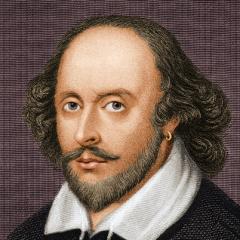
“Well, I must do’t. Away, my disposition, and possess me Some harlot’s spirit! My throat of war be turn’d, Which quier’d with my drum, into a pipe Small as an eunuch, or the virgin voice That babies lull asleep! The smiles of knaves Tent in my cheeks, and schoolboys’ tears take up The glasses of my sight! A beggar’s tongue Make motion through my lips, and my arm’d knees, Who bow’d but in my stirrup, bend like his That hath receiv’d an alms! I will not do’t, Lest I surcease to honor mine own truth, And by my body’s action teach my mind A most inherent baseness.”

Quote by William Shakespeare

Work

Coriolanus

William Shakespeare's 'Coriolanus' is a tragedy that delves into the complexities of political ambition and the consequences of public versus private life. The story follows the rise and fall of Coriolanus, a valiant Roman general who becomes embroiled in a power struggle within the Roman Republic. The play examines themes of patriotism, loyalty, and the nature of leadership, as Coriolanus grapples with his own identity and the expectations of his fellow citizens. As the narrative unfolds, Coriolanus's actions lead to a series of conflicts that ultimately result in his downfall. The play is renowned for its vivid portrayal of human emotions and its exploration of the political landscape of ancient Rome. more

Author

William Shakespeare
William Shakespeare

William Shakespeare (1564 - April 23, 1616) was one of the greatest poets of the English Renaissance, renowned for his dramatic works. His plays spanned a variety of genres, including tragedy, comedy, and history, and have had a profound impact on literature worldwide. more

You May Also Like

“My wife comes foremost; then the honour'd mould Wherein this trunk was framed, and in her hand The grandchild to her blood. But, out, affection! All bond and privilege of nature, break! Let it be virtuous to be obstinate. What is that curt'sy worth? or those doves' eyes, Which can make gods forsworn? I melt, and am not Of stronger earth than others. My mother bows; As if Olympus to a molehill should In supplication nod: and my young boy Hath an aspect of intercession, which Great nature cries 'Deny not.' let the Volsces Plough Rome and harrow Italy: I'll never Be such a gosling to obey instinct, but stand, As if a man were author of himself And knew no other kin.”

“You can spread an ideology only by bombs. Either by real bombs or love bombs (manipulation).”

“That's the thing about war: it's never enough to disable the buildings, to blow holes into their middles; instead, they're hit over and over again, as if to pound them to dust, to disintegrate them, to remove them from the earth, to deny that families ever lived in them. But people did live there. And they needed to return, even though there was nothing left to return to except forbidding piles of broken concrete and cable wires sticking out of the heaps like markers of malevolence.”

“In 1969 the Khmer Rouge numbered only about 4,000. By 1975 their numbers were enough to defeat the government forces. Their victory was greatly helped by the American attack on Cambodia, which was carried out as an extension of the Vietnam War. In 1970 a military coup led by Lon Nol, possibly with American support, overthrew the government of Prince Sihanouk, and American and South Vietnamese troops entered Cambodia. One estimate is that 600,000 people, nearly 10 per cent of the Cambodian population, were killed in this extension of the war. Another estimate puts the deaths from the American bombing at 1000,000 peasants. From 1972 to 1973, the quantity of bombs dropped on Cambodia was well over three times that dropped on Japan in the Second World War. The decision to bomb was taken by Richard Nixon and Henry Kissinger and was originally justified on the grounds that North Vietnamese bases had been set up in Cambodia. The intention (according to a later defence by Kissinger’s aide, Peter W. Rodman) was to target only places with few Cambodians: ‘From the Joint Chiefs’ memorandum of April 9, 1969, the White House selected as targets only six base areas minimally populated by civilians. The target areas were given the codenames BREAKFAST, LUNCH, DINNER, SUPPER, SNACK, and DESSERT; the overall programme was given the name MENU.’ Rodman makes the point that SUPPER, for instance, had troop concentrations, anti-aircraft, artillery, rocket and mortar positions, together with other military targets. Even if relatively few Cambodians were killed by the unpleasantly names items on the MENU, each of them was a person leading a life in a country not at war with the United States. And, as the bombing continued, these relative restraints were loosened. To these political decisions, physical and psychological distance made their familiar contribution. Roger Morris, a member of Kissinger’s staff, later described the deadened human responses: Though they spoke of terrible human suffering reality was sealed off by their trite, lifeless vernacular: 'capabilities', 'objectives', 'our chips', 'giveaway'. It was a matter, too, of culture and style. They spoke with the cool, deliberate detachment of men who believe the banishment of feeling renders them wise and, more important, credible to other men… They neither understood the foreign policy they were dealing with, nor were deeply moved by the bloodshed and suffering they administered to their stereo-types. On the ground the stereotypes were replaced by people. In the villages hit by bombs and napalm, peasants were wounded or killed, often being burnt to death. Those who left alive took refuge in the forests. One Western ob-server commented, ‘it is difficult to imagine the intensity of their hatred to-wards those who are destroying their villages and property’. A raid killed twenty people in the village of Chalong. Afterwards seventy people from Chalong joined the Khmer Rouge. Prince Sihanouk said that Richard Nixon and Henry Kissinger created the Khmer Rouge by expanding the war into Cambodia.”