Quotessence
Home / Quotes / Quote by Thomas Mann

Quote by Thomas Mann

“he spoke to him of the hot terror which the initiate suffer when their eyes light on an image of the eternal beauty; spoke of the greed of the impious and the wicked who cannot think beauty when they see its likeness, and who are incapable of reverence; spoke of the heavy distress which befalls the noble-minded when a godlike countenance, a perfect body, appears before them; they tremble and grow distracted, and hardly dare to raise their eyes, and they honor the one who posses this beauty, yes, if they were not afraid of being thought downright madmen they would sacrifice to the beloved as to the image of a god. For beauty, my Phaedrus, beauty alone is both lovely and visible at once; it is, mark me, the only form of the spiritual which we can receive through the senses.”

Quote by Thomas Mann

Work

Death in Venice

In this novella, the protagonist, an aging writer, becomes entranced by the beauty of Venice and its inhabitants. His fascination leads to a complex relationship with a young boy, which ultimately results in a profound existential crisis. The story delves into the complexities of artistic creation and the moral dilemmas faced by the protagonist amidst the backdrop of the picturesque and decaying city of Venice. more

Author
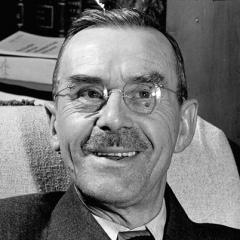
Thomas Mann
Thomas Mann

Thomas Mann, born on June 6, 1875, and died on August 12, 1955, was a German novelist and one of the greatest writers of the 20th century. Known for his profound psychological portrayals and rich imagination, his works extensively covered themes such as individual and society, history and reality. His masterpieces include 'Buddenbrooks' and 'The Magic Mountain'. more

You May Also Like

“Honestly kiddo? You’re beautiful. You use your weight as an excuse but you’re just all woman. Not every woman has to look like a stripper. Or a model. Or Megan Fox. You’re petite, have a tiny waist, a fantastic rack, a devastating ass…what the hell more do you want? You should know it. Everyone else knows it…that’s why you’re getting all these asinine comments. Can’t you just see that it’s just jealously that’s ripping these people apart?”

“His mouth was a little too wide and snaked from corner to corner. His nose had been broken a few times, and when you looked at him straight on like I was doing as I stared at him across the circle bar, you could really tell. But his eyes were beautiful, cunning and otherworldly. His hair was a controlled mess; wispy dark strands that swooped across his forehead with long sideburns. He had high cheekbones, a strong jawline. When you combined all the parts, they equaled so much more than the sum. He was exotically, dangerously beautiful. He'd been mine once. He'd broken my heart once. And he was here to kill me. He only needed to do that once, too.”

“Here's something to consider: anything manmade had to have began first in the world of particles, protons, neutrons, electrons, atoms, and other forms of elements and matter. It's all there: airplanes, trains, vehicles, computers, and all things manmade. Even future inventions already exist. Think about it like a puzzle. Before it's pieced together, it's just pieces. But the puzzle is still there. It's basically the same principle.”

“— Vous n'êtes pas sûr de ce que vous dites ? Vous allez de nouveau changer, vous déplacer par rapport aux questions qu'on vous pose, dire que les objections ne pointent pas réellement vers le lieu où vous vous prononcez ? Vous vous préparez à dire encore une fois que vous n'avez jamais été ce qu'on vous reproche d'être ? Vous aménagez déjà l'issue qui vous permettra, dans votre prochain livre, de resurgir ailleurs et de narguer comme vous le faites maintenant : non, non je ne suis pas là où vous me guettez, mais ici d'où je vous regarde en riant. — Eh quoi, vous imaginez-vous que je prendrais à écrire tant de peine et tant de plaisir, croyez-vous que je m'y serais obstiné, tête baissée, si je ne préparais — d'une main un peu fébrile — le labyrinthe où m'aventurer, déplacer mon propos, lui ouvrir des souterrains, l’enfoncer loin de lui-même, lui trouver des surplombs qui résument et déforment son parcours, où me perdre et apparaître finalement à des yeux que je n'aurai jamais plus à rencontrer. Plus d'un comme moi sans doute, écrivent pour n'avoir plus de visage. Ne me demandez pas qui je suis et ne me dites pas de rester le même : c'est une morale d'état civil; elle régit nos papiers. Qu'elle nous laisse libres quand il s'agir d'écrire.”