Quotessence
Home / Quotes / Quote by Norton Juster

Quote by Norton Juster

“It's completely logical," explained the Dodecahedron. "The more you want, the less you get, and the less you get, the more you have. Simple arithmetic, that's all. Suppose you had something and added something to it. What would that make?" "More," said Milo quickly. "Quite correct," he nodded. "Now suppose you had something and added nothing to it. What would you have?" "The same," he answered again, without much conviction. "Splendid," cried the Dodecahedron. "And suppose you had something and added less than nothing to it. What would you have then?" "FAMINE!" roared the anguished Humbug, who suddenly realized that that was exactly what he'd eaten twenty-three bowls of.”

Quote by Norton Juster

Work

The phantom tollbooth

In this classic children's book, Milo, a bored and uninterested boy, is transported into a magical realm where he encounters various characters and challenges. The story combines elements of fantasy, humor, and intellectual exploration, encouraging readers to think critically and enjoy the beauty of language and imagination. more

Author
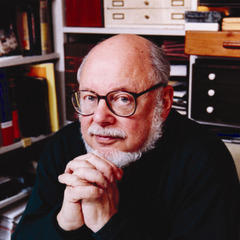
Norton Juster
Norton Juster

Norton Juster is an American author renowned for his children's literature. His most famous work, 'Charlotte's Web,' has been a beloved classic since its publication in 1952. Beyond children's literature, Juster has also ventured into adult fiction and poetry. more

You May Also Like

“The man who cannot believe his senses, and the man who cannot believe anything else, are both insane, but their insanity is proved not by any error in their argument, but by the manifest mistake of their whole lives. They have both locked themselves up in two boxes, painted inside with the sun and stars; they are both unable to get out, the one into the health and happiness of heaven, the other even into the health and happiness of the earth.”

“War, famine, disease, genocide. Death, in a million different forms, often painful and protracted for the poor individual wretches involved. What god would so arrange the universe to predispose its creations to experience such suffering, or be the cause of it in others? What master of simulations or arbitrator of a game would set up the initial conditions to the same pitiless effect? God or programmer, the charge would be the same: that of near-infinitely sadistic cruelty; deliberate, premeditated barbarism on an unspeakably horrific scale.” Hyrlis looked expectantly at them. “You see?” he said. “By this reasoning we must, after all, be at the most base level of reality – or at the most exalted, however one wishes to look at it. Just as reality can blithely exhibit the most absurd coincidences that no credible fiction could convince us of, so only reality – produced, ultimately, by matter in the raw – can be so unthinkingly cruel. Nothing able to think, nothing able to comprehend culpability, justice or morality could encompass such purposefully invoked savagery without representing the absolute definition of evil. It is that unthinkingness that saves us. And condemns us, too, of course; we are as a result our own moral agents, and there is no escape from that responsibility, no appeal to a higher power that might be said to have artificially constrained or directed us.”

“And the Buddha pointed out that his confusion was justified, for 'the dharma is profound, difficult to see, difficult to understand, peaceful, excellent, beyond the sphere of logic, subtle, and to be understood by the wise'. The reason for this is that it is not readily comprehended by one who holds a different view and has different learnings and inclinations, different involvements and instruction. It is clear from this statement that the conception of nibbāna in beyond logical reasoning, not because it is an Ultimate Reality transcending logic, but because logic or reason, being the 'slave of passions', makes it difficult for one who has a passion for an alien tradition to understand the conception of nibbāna.”