Quotessence
Home / Quotes / Quote by Garrett Hardin

Quote by Garrett Hardin

“Quoting page 235: Universalism: The Promiscuous Altruism At one extreme of the spectrum of discriminating altruisms lies universalism, altruism that is practiced without discrimination of kinship, shared values, acquaintanceship, propinquity in time or space, or any other characteristic. An immense literature has grown up promoting an ideal expressed well by a now forgotten poet at the end of World War I: “Let us no more be true to boasted race or clan / but to our highest dream, the brotherhood of man.” This sounds lovely, but what kind of altruism does it praise? Clearly the poem is a paean to “promiscuous” altruism. Promiscuity should always be challenged. Pierre-Joseph Proudhon (1809-1865) said, “If all the world is my brother, then I have no brother.” The specific shortcoming of universalism is easy to identify: it promotes a pathology that was identified in the preceding chapter, namely the tragedy of the commons.”

Quote by Garrett Hardin

Work

Living within Limits: Ecology, Economics, and Population Taboos

Living within Limits: Ecology, Economics, and Population Taboos delves into the complex relationship between environmental sustainability, economic systems, and population growth. The book challenges traditional taboos and offers insights into the challenges and solutions related to managing finite resources and balancing human needs with ecological limits. more

Author
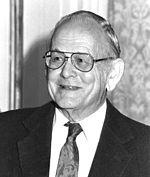
Garrett Hardin
Garrett Hardin

Garrett Hardin, an ecologist, was born on April 21, 1915, and passed away on September 14, 2003. He is renowned for his theory of the 'Tragedy of the Commons,' which explores the issue of resource overuse. more

You May Also Like

“The Overton window is the range of policies politically acceptable to the mainstream population at a given time. It is also known as the window of discourse. The term is named after Joseph P. Overton, who stated that an idea's political viability depends mainly on whether it falls within this range, rather than on politicians' individual preferences. The Overton Window is an approach to identifying the ideas that define the spectrum of acceptability of governmental policies. Politicians can only act within the acceptable range. Shifting the Overton Window involves proponents of policies outside the window persuading the public to expand the window. Proponents of current policies, or similar ones within the window, seek to convince people that policies outside it should be deemed unacceptable. In 1998, Noam Chomsky said: "The smart way to keep people passive and obedient is to strictly limit the spectrum of acceptable opinion, but allow very lively debate within that spectrum—even encourage the more critical and dissident views. That gives people the sense that there's free thinking going on, while all the time the presuppositions of the system are being reinforced by the limits put on the range of the debate.”

“YouTube: “Dr. Jordan Peterson | Is Neo-Marxism on the rise?” I think the group identity game ends in blood. It doesn’t matter who plays it. Left-wingers play it: blood. Right-wingers play it: blood. And lots of it, not just a little of it. You can’t play the identity politics game. Well, so what do you do instead? You live the mythologically heroic life as an individual. That’s the right place to work. And that’s the message of the West, as far as I’m concerned is that we figure that out. We figured out that the collective identity was not the pinnacle statement.”

“pp. 6-7: I want America to return to the ideal of treating people as individuals, so I have to write a book that treats Americans as groups. But there’s no way around it. Those of us who want to defend the American creed have been unwilling to say openly that races have significant group differences. Since we have been unwilling to say that, we have been defenseless against claims that racism is to blame for unequal outcomes. What else could it be? We have been afraid to answer candidly.”

“Page 244: The Jewish involvement in influencing immigration policy in the United States is especially noteworthy as an aspect of ethnic conflict. ... Throughout much of the period from 1881 to 1965, one Jewish interest in liberal immigration policies stemmed from a desire to provide a sanctuary for Jews fleeing from anti-Semitic persecutions in Europe and elsewhere. ... There is also evidence that Jews, much more than any other European-derived ethnic group in the United States, have viewed liberal immigration policies as a mechanism of ensuring that the United States would be a pluralistic rather than a unitary, homogeneous society (e.g., Cohen 1972). ... Pluralism serves internal Jewish interests because it legitimates the internal Jewish interest in rationalizing ... Jewish group commitment and non-assimilation, what Howard Sachar (1992, 427) terms its function in “legitimizing the preservation of a minority culture in the midst of a majority’s host society.” ... Ethnic and religious pluralism also serves external Jewish interests because Jews become just one of many ethnic groups. This results in the diffusion of political and cultural influence among the various ethnic and religious groups, and it becomes difficult or impossible to develop unified, cohesive groups of gentiles united in their opposition to Judaism. Historically, major anti-Semitic movements have tended to erupt in societies that have been, apart from the Jews, religiously or ethnically homogeneous.”

“A land acknowledgement or territorial acknowledgement is a formal statement, often spoken at the beginning of a public event, that it is taking place on land originally inhabited by or belonging to indigenous people. In Canada, land acknowledgements became popular after the 2015 Truth and Reconciliation Commission report (which argued that the country's Indian residential school system had amounted to cultural genocide) and the election of liberal prime minister Justin Trudeau that same year.[2] By 2019, they were a regular practice at events including National Hockey League games, ballet performances and parliament meetings. Critics of land acknowledgements have described them as excesses of political correctness or expressed concerns that they amount to empty gestures that avoid actually addressing the issues of indigenous communities. Ensuring the factual accuracy of acknowledgments can be difficult due to problems like conflicting land claims or unrecorded land exchanges between indigenous groups. In the United States, the practice of land acknowledgements has been described as "catching on" as of 2020.”

“Pathological altruism refers to sincere attempts to help others that instead harms others or oneself and where this harm could have been reasonably anticipated. It is often caused by cognitive and/or emotional biases that blind people to the potentially harmful consequences of their actions. Altruistic intentions must be run through the sieve of rational analysis; all too often, the best long-term action to help others, at both personal and public scales, is not immediately or intuitively obvious, not what temporarily makes us feel good, and not what is being promoted by other individuals, with their own potentially self-serving interests. Indeed, truly altruistic actions may sometimes appear cruel or harmful, the equivalent of saying “no” to the student who demands a higher grade or to the addict who needs another hit. However, the social consequences of appearing cruel in a culture that places high value on kindness, empathy, and altruism can lead us to misplaced “helpful” behavior and result in self-deception regarding the consequences of our actions. In some cases, some people gain some benefit from the altruism, but other people and/or the altruist are harmed in ways that could be reasonably predicted, but are not due to such biases. These altruistic biases may be deliberately exploited by some people in order to gain benefits at the expense of other people. Feelings of self-righteousness and sanctimony have been described as being an intensely pleasurable addiction for some people, which contributes to blind pathological altruism and rejection of logical arguments.”