Quotessence
Home / Quotes / Quote by Victor Hugo

Quote by Victor Hugo

“L’algèbre s’applique aux nuages ; l’irradiation de l’astre profite à la rose; aucun penseur n’oserait dire que le parfum de l’aubépine est inutile aux constellations. Qui donc peut calculer le trajet d’une molécule? Que savons-nous si des créations de monde ne sont point déterminées par des chutes de grains de sable? Qui donc connaît les flux et les reflux réciproques de l’infiniment grand et de l’infiniment petit, le retentissement des causes dans les précipices de l’être et les avalanches de la création? […] Tous les oiseaux qui volent ont à la patte le fil de l’infini. […] Dans les vastes échanges cosmiques, la vie universelle va et vient en quantités inconnues, roulant tout dans l’invisible mystère des effluves, […] rattachant le vol d’un insecte au mouvement de la terre, subordonnant, qui sait? ne fût-ce que par l’identité de la loi, l’évolution de la comète dans le firmament au tournoiement de l’infusoire dans la goutte d’eau. Machine faite d’esprit. Engrenage énorme dont le premier moteur est le moucheron et dont la dernière roue est le zodiaque.”

Quote by Victor Hugo

Work

Les Misérables

Victor Hugo's 'Les Misérables' is an epic narrative that delves into the lives of various characters, including Jean Valjean, a former convict seeking redemption, and Fantine, a woman struggling in poverty. The story is rich in historical detail and moral complexity, offering a profound examination of society's flaws and the resilience of the human spirit. more

Author
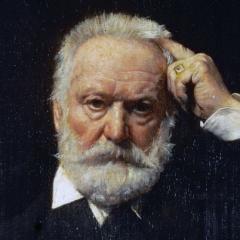
Victor Hugo
Victor Hugo

Victor Hugo, a French romantic poet, novelist, and playwright, was born on February 26, 1802, and died on May 22, 1885. He is considered one of the greatest writers in French literary history, known for his profound humanistic concerns and rich imagination. more

You May Also Like

“Children’s bodies and brains are still in an early developmental stage of growth until at least the age of three. To inject infants with a variety of vaccines, which contain toxins and materials the body will recognize as foreign contaminants seems an ill-conceived “health” policy. Before the age of one, it is not recommended by our healthcare organizations to allow a child to eat honey, because a child’s system is not developed enough to handle “natures perfect food.” Currently, we are not only injecting infants with a plethora of vaccines in their first year but are starting them out with a vaccine on their first day on the planet. Is it any wonder why we have such rampant illness in the infant and adolescent population today? A little common sense appears to be needed here.”

“There is a universal reservoir, the source of all knowledge, which is the same for the arts and sciences as for philosophy and religion. In a way, science is an art. In some ways, religion is philosophy because philosophy and religion often deal with the same questions—with the first and the final causes, among others. Religious people a priori “bet” on God, whereas philosophers may bet on God or not. The difference in approach toward God between religion and philosophy is that religion imposes and prescribes God, and philosophy offers the freedom of thought and choice. Religious prescriptions of God are not proof of faith or God’s existence, but rather the opposite—they prove that philosophy is more “religious” than religion because it doesn’t steal God from people but offers freedom.”

“Canonization, limitation, and reduction of God to a “few” sentences are inconceivable attempts to kill and expel God from people under the excuse that God is doing that. There is no weakness in science and language as instruments. There is no excuse. There is only human power and weakness. Understanding depends on the balance between human strengths and weaknesses.”

“The world was ready for greater discoveries two thousand years ago. (Heron of Alexandria is an excellent example of an inventor who invented the first steam engine, aeolipile.) There was a basis for it. Only the language to translate abstract ideas and symbols into the language of science was missing. The only obstacle to a human being is a human being himself. The only limitation comes from the inability to dream and pierce into the essence that permeates all that exists in the universe. There is the same law for a galaxy, for a man, and for an ant. Basic principles are the same everywhere; they never change and exist as long as the universe exists.”

“God is not absolute, and Nothingness is not absolute. If we come from these positions (postulates), we confront the inability of language to be precise. This inability reveals that the problem of understanding different phenomena is not so much in the phenomena themselves but in our failure to understand or present them linguistically in the best and most precise manner.”

“God, or to put it better, our idea of God, is a concept before anything else. The way God had been (mainly) understood throughout history leads to the idea of God as an entity beyond the world that creates the world and stays beyond the world but affects it. There is no proof for this, but the concept itself, by its nature, is a theoretical expression or view of a particular phenomenon. As such, applied to something invisible or tangible and visible, it is subject to change.”

“Many concepts and ideas become laws in time, like the laws of physics. In time, many of these same concepts lose validity in favor of new concepts that become new laws. These phenomena lead to the progress of science; otherwise, some concepts, which were previously laws, would always stay the same regardless of whether they were correct.”

“New concepts or laws would not be possible without the preceding concepts or laws. What we refuse today as incorrect is the basis for something we accept as correct tomorrow. Then the question arises—if the preceding concept was incorrect, how is it possible that the new concept, or law, that we think is correct can be based on the previous and rejected one? Something “incorrect” cannot be the basis for something correct. In this way, we conclude that even those laws (concepts) we reject today as incorrect contain the elements of a new law or concept or something that we think is correct or more correct. The world's universal nature cannot be wholly apprehended and observed by the human mind. All this happens while the laws stay the same; only our ideas and concepts about the laws change, not the laws or the truth (fact) itself.”