Quotessence
Home / Quotes / Quote by Janet Fitch

Quote by Janet Fitch

“The question of good and the nature of evil will always be on of philosophy’s most intriguing problems, up there with the problem of existence itself. I’m not quarreling with your choice of issues, only with your intellectually diminished approach. If evil means to be self-motivated, to be the center of one’s own universe, to live on one’s own terms, then every artiste every thinker, every original mind, is evil. Because we dare to look through our own eyes rather than mouth clichés lent us from the so-called Fathers. To dare to see is to steal fire from the Gods. This is mankind’s destiny, the engine which fuels us as a race.”

Quote by Janet Fitch

Work

White Oleander

White Oleander is a work of fiction that follows the life of Astrid Magnussen, a girl whose mother, Ingrid, is a brilliant but narcissistic poet. After Ingrid is sentenced to prison for murder, Astrid is placed into a series of foster homes across Southern California. Each home presents a different set of challenges and influences, shaping Astrid's identity as she grows from a child into a young woman. The narrative explores themes of resilience, the search for belonging, and the powerful, often destructive, bond between mother and daughter. The title refers to a poisonous flowering shrub, serving as a metaphor for Ingrid's beautiful yet dangerous influence on her daughter's life. more

Author

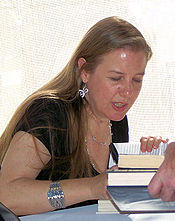
Janet Fitch
Janet Fitch

Janet Fitch is a renowned American contemporary author, born on November 9, 1955, in California. Her works are known for their profound character development and unique narrative style, with notable titles including 'The Geeks' and 'Paint It Black'. more

You May Also Like

“The mirror tosses back a version of me as if it has been whirled through a cosmic blender, morphing into shapes that don't quite stick. It's not only a reflection staring back but a whole gallery of emotions, imprisoned into a perpetual loop —hope flickers, despair looms, joy bursts, and pain shadows. They all merge into faces I swear I've known and echoes of a past I carry, recklessly pieced together in a spectacle of what it means to be achingly, beautifully human.”

“It has been said, in a tone of reproach, that Machiavelli makes no attempt *to persuade'. Certainly he was no prophet. For he was concerned first of all with truth, not with persuasion, which is one reason why his prose is great prose, not only of Italian but a model of style for any language. He is a partial Aristotle of politics. But he is partial not because his vision is distorted or his judgment biased, or because of any lack of moral interest, but because of his sole passion for the unity, peace, and prosperity of his country. What makes him a great writer, and for ever a solitary figure, is the purity and single-mindedness of his passion. No one was ever less Machiavellian' than Machiavelli. Only the pure in heart can blow the gaff on human nature as Machiavelli has done. The cynic can never do it; for the cynic is always impure and sentimental. But it is easy to understand why Machiavelli was not himself a successful politician. For one thing, he had no capacity for self-deception or self-dramatization. The recipe dors ton sommeil de brute is applied in many forms, of which Calvin and Rousseau give two variations; but the utility of Machiavelli is his perpetual summons to examination of the weakness and impurity of the soul. We are not likely to forget his political lessons, but his examination of conscience may be too easily overlooked.”