Quotessence
Home / Quotes / Quote by Mervyn Peake

Quote by Mervyn Peake

“But his mind saw nothing of all this. His mind was engaged in a warfare of the gods. His mind paced outwards over no-man's-land, over the fields of the slain, paced to the rhythm of the blood's red bugles. To be alone and evil! To be a god at bay. What was more absolute?”

Quote by Mervyn Peake

Work

Gormenghast

Evelyn Waugh's 'Gormenghast' is a dark, satirical novel that delves into the life of the mysterious and reclusive Count of Gormenghast and his descendants. The story is narrated by Steerpike, a young man who becomes entangled in the castle's intricate web of politics and intrigue. The novel is renowned for its complex structure, elaborate language, and its portrayal of a world that is both fantastical and deeply rooted in the human condition. more

Author

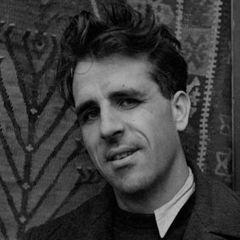
Mervyn Peake
Mervyn Peake

Mervyn Peake was a British writer renowned for his imaginative and distinctive works. He is most celebrated for his Gormenghast series, a blend of fantasy, satire, and horror that has become a cornerstone of modern fantasy literature. Peake's writing is characterized by its vivid descriptions and complex characters. more

You May Also Like

“When Van Gogh was a young man in his early twenties, he was in London studying to be a clergyman. He had no thought of being an artist at all. he sat in his cheap little room writing a letter to his younger brother in Holland, whom he loved very much. He looked out his window at a watery twilight, a thin lampost, a star, and he said in his letter something like this: "it is so beautiful I must show you how it looks." And then on his cheap ruled note paper, he made the most beautiful, tender, little drawing of it. When I read this letter of Van Gogh's it comforted me very much and seemed to throw a clear light on the whole road of Art. Before, I thought that to produce a work of painting or literature, you scowled and thought long and ponderously and weighed everything solemnly and learned everything that all artists had ever done aforetime, and what their influences and schools were, and you were extremely careful about *design* and *balance* and getting *interesting planes* into your painting, and avoided, with the most astringent severity, showing the faintest *acedemical* tendency, and were strictly modern. And so on and so on. But the moment I read Van Gogh's letter I knew what art was, and the creative impulse. It is a feeling of love and enthusiasm for something, and in a direct, simple, passionate and true way, you try to show this beauty in things to others, by drawing it. And Van Gogh's little drawing on the cheap note paper was a work of art because he loved the sky and the frail lamppost against it so seriously that he made the drawing with the most exquisite conscientiousness and care.”

“All of that art-for-art’s-sake stuff is BS,” she declares. “What are these people talking about? Are you really telling me that Shakespeare and Aeschylus weren’t writing about kings? All good art is political! There is none that isn’t. And the ones that try hard not to be political are political by saying, ‘We love the status quo.’ We’ve just dirtied the word ‘politics,’ made it sound like it’s unpatriotic or something.” Morrison laughs derisively. “That all started in the period of state art, when you had the communists and fascists running around doing this poster stuff, and the reaction was ‘No, no, no; there’s only aesthetics.’ My point is that is has to be both: beautiful and political at the same time. I’m not interested in art that is not in the world. And it’s not just the narrative, it’s not just the story; it’s the language and the structure and what’s going on behind it. Anybody can make up a story.”

“Art can blow us out of our pigeon hole. In deafness it may shout or scream, in blindness it may arrest our attention, in numbness it may shake up our mind. If we don’t sense anything at all and take everything for granted, art can kick us in the ass, give a conscience and make us aware. ("When is Art?")”