Quotessence
Home / Quotes / Quote by Eckhart Tolle

Quote by Eckhart Tolle

“I don't know" is not confusion. Confusion is "I don't know, but I should know" or "I don't know, but I need to know." When you fully accept that you don't know, you actually enter a state of peace and clarity that is closer to who you truly are than thought could ever be. Defining yourself through thought is limiting yourself.”

Quote by Eckhart Tolle

Work

A New Earth: Awakening to Your Life's Purpose

Browse quotes and source details for this work. more

Author
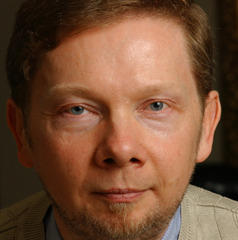
Eckhart Tolle
Eckhart Tolle

Eckhart Tolle is a German-born author and philosopher, renowned for his book 'The Power of Now'. His work primarily focuses on personal awakening, self-awareness, and inner peace. Born on February 16, 1948, Tolle's ideas have influenced countless individuals seeking spiritual growth and inner freedom. more

You May Also Like

“More than ninety-five percent of your brain activity, as you consciously read this sentence, is being used by your subconscious mind.”

“It is well understood in psychology that the subconscious mind has the dominant influence on human decision making, and therefore the pivotal role of the subconscious, for you to achieve success, is inescapable.”

“There seemed no answer. He wasn't resigned to anything, he hadn't accepted or adjusted to the life he'd been forced into. Yet here he was, eight months after the plague's last victim, nine since he's spoken to another human being, ten since Virginia had died. Here he was with no future and a virtually hopeless present. Still plodding on. Instinct? Or was he just stupid? Too unimaginative to destroy himself? Why hadn't he done it in the beginning when he was in the very depths? What had impelled him to enclose the house, install a freezer, a generator, an electric stove, a water tank, build a hothouse, a workbench, burn down the houses on each side of his, collect records and books and mountains of canned supplies, even - it was fantastic when you thought about it - even put a fancy mural on the wall? Was the life force something more than words, a tangible, mind-controlling potency? Was nature somehow, in him, maintaining its spark against its own encroachments? He closed his eyes. Why think, why reason? There was no answer. His continuance was an accident and an attendant bovinity. He was just too dumb to end it all, and that was about the size of it.”

“Self-reflection or autognosis reveals that what is given in consciousness is, first and foremost, integral connectedness and organic unity of all thinking, feeling, and desiring. At the same time, self-reflection reveals that this connected unity is the ultimate reality that can be reached. "Consciousness cannot go behind itself." Whatever we propose to think forms part of this organic unity of our mind and is a result or consequence of it. There is no means of jumping beyond consciousness, and any attempt to explain with the help of any other imaginary system the radical connectedness in which we live and that is our mind would be absurd. Our mind is the very presupposition of all explanation. For to explain a phenomenon means, in the last instance, to point out its place and its part within the living economy of consciousness, and to determine the "meaning" it has in the original source of all meaning: life.”