“As simple as that sounds, it is nevertheless extremely difficult to adequately discuss no-boundary awareness or nondual consciousness. This is because our language — the medium in which all verbal discussion must float — is a language of boundaries. As we have seen, words and symbols and thoughts themselves are actually nothing but boundaries, for whenever you think or use a word or name, you are already creating boundaries. Even to say "reality is no-boundary awareness" is still to create a distinction between boundaries and no-boundary! So we have to keep in mind the great difficulty involved with dualistic language. That "reality is no-boundary" is true enough, provided we remember that no-boundary awareness is a direct, immediate, and nonverbal awareness, and not a mere philosophical theory. It is for these reasons that the mystic-sages stress that reality lies beyond names and forms, words and thoughts, divisions and boundaries. Beyond all boundaries lies the real world of Suchness, the Void, the Dharmakaya, Tao, Brahman, the Godhead. And in the world of suchness, there is neither good nor bad, saint nor sinner, birth nor death, for in the world of suchness there are no boundaries.”
Quote by Ken Wilber
Work
The book delves into various philosophical and spiritual traditions from both Eastern and Western cultures, examining their methods and teachings that contribute to personal development and self-realization. more
Author
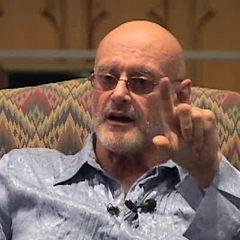
Ken Wilber is an American writer and philosopher, born on January 31, 1949. He is the founder of Integral Theory, which aims to integrate human knowledge, philosophy, psychology, and religion. Wilber's work covers a wide range of fields, including personal growth, spiritual development, and cultural studies. more
You May Also Like
“Trying to eliminate worldly temptations only makes our spiritual growth limited.”
“Do wipe the sky once I leave मेरे जाने के बाद आसमां पोंछ लेना”
“For an incurious person, an open door will be no different than a wall!”
“Every time you give away love without any expectations, you become richer.”