Quotessence
Home / Quotes / Quote by Franz Kafka

Quote by Franz Kafka

“Anyone who cannot come to terms with his life while he is alive needs one hand to ward off a little his despair over his fate –he has little success in this –but with his other hand he can note down what he sees among the ruins, for he sees different (and more) things than do the others; after all, dead as he is in his own lifetime, he is the real survivor. This assumes that he does not need both hands, or more hands than he has, in his struggle against despair.”

Quote by Franz Kafka

Work

Diaries, 1910-1923

Browse quotes and source details for this work. more

Author

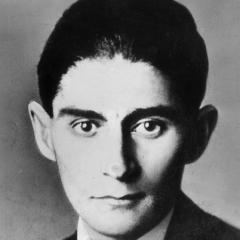
Franz Kafka
Franz Kafka

Franz Kafka (July 3, 1883 - June 3, 1924) was an important German-language novelist of the 20th century, known for his unique literary style and profound philosophical thoughts. His works, often themed around loneliness, alienation, and existentialism, have had a profound impact on literature and philosophy. more

You May Also Like

“Manon died in the desert, but in the arms of the man who loved her with the the entire brilliance of his soul, who, when she was dead, dug a grave for her, and watered it with his tears, then buried his own heart within it.. While Marguerite, a Sinner like Manon, had died in a sumptuous bed... But in that desert of the heart, a more barren, a vaster, a more merciless desert, than that in which Manon had found her last resting place.”

“It was at Auschwitz that human beings underwent their first mutations. Without Auschwitz, there would have been no Hiroshima. Or genocide in Africa. Or attempts to dehumanize man by reducing him to a number, an object: it was at Auschwitz that the methods to be used were conceived, catalogued, and perfected. It was at Auschwitz that men mutilated and gambled with the future. The despair begotten at Auschwitz will linger for generations.”

“I notice that when the other person has been in despair for a prolonged period, I begin to feel myself crumbling into discouragement internally. One of the ways my system seeks to protect both me and the other person is to activate into helpful doing. Even though it is a psuedo-engagement, the intent is to shelter both of us from being engulfed in despair.”

“For after all, why do we go on fighting? If we die for democracy then we must be one of the democracies. Let the rest fight with us, if that is the case. But the most powerful of them, the only one that could save us, chooses to bide its time. Very good. That is its right. But by so doing, that democracy signifies that we are fighting for ourselves alone. And we go on fighting despite the assurance that we have lost the war. Why, then, do we go on dying? Out of despair? But there is no despair. You know nothing about defeat if you think there is room in it for despair. There is a verity that is higher than the pronouncements of the intelligence. There is a thing which pierces and governs us and which cannot be grasped by the intelligence. A tree has no language. We are a tree. There are truths which are evident, though not to be put into words. I do not die in order to obstruct the path of the invasion, for there is no shelter upon which I can fall back with those I love. I do not die to preserve my honor, since I deny that my honor is at stake, and I challenge the jurisdiction of my judge. Nor do I die out of desperation.”