Quotessence
Home / Quotes / Quote by Janet Fitch

Quote by Janet Fitch

“Rena noticed me watching it pass. 'You think they don't got problem?' Rena said. 'Everybody got problem. You got me, they got insurance, house payment, Preparation H.' She smiled, baring the part between her two upper teeth. 'We are the free birds. They want to be us.”

Quote by Janet Fitch

Work

White Oleander

White Oleander is a work of fiction that follows the life of Astrid Magnussen, a girl whose mother, Ingrid, is a brilliant but narcissistic poet. After Ingrid is sentenced to prison for murder, Astrid is placed into a series of foster homes across Southern California. Each home presents a different set of challenges and influences, shaping Astrid's identity as she grows from a child into a young woman. The narrative explores themes of resilience, the search for belonging, and the powerful, often destructive, bond between mother and daughter. The title refers to a poisonous flowering shrub, serving as a metaphor for Ingrid's beautiful yet dangerous influence on her daughter's life. more
Author

Janet Fitch
Janet Fitch

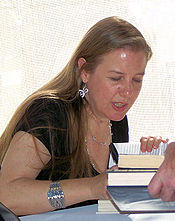
Janet Fitch is a renowned American contemporary author, born on November 9, 1955, in California. Her works are known for their profound character development and unique narrative style, with notable titles including 'The Geeks' and 'Paint It Black'. more

You May Also Like

“The modern West has been deeply split about freedom and responsibility. On the one hand, it has championed human freedom in many forms - human rights, sexual freedom, political liberty, freedom to choose in many spheres. On the other hand, many of its most intelligent members have not believed that people are free at all, and have devoted great efforts to show that really we are the product of our genes, our unconscious drives, our education, economic pressures, or other forms of conditioning.”

“Art, literature, and philosophy are attempts to found the world anew on a human freedom: that of the creator; to foster such an aim, one must first unequivocally posit oneself as a freedom. The restrictions that education and custom impose on a woman limit her grasp of the universe...Indeed, for one to become a creator, it is not enough to be cultivated, that is, to make going to shows and meeting people part of one's life; culture must be apprehended through the free movement of a transcendence; the spirit with all its riches must project itself in an empty sky that is its to fill; but if a thousand fine bonds tie it to the earth, its surge is broken. The girl today can certainly go out alone, stroll in the Tuileries; but I have already said how hostile the street is: eyes everywhere, hands waiting: if she wanders absentmindedly, her thoughts elsewhere, if she lights a cigarette in a cafe, if she goes to the cinema alone, an unpleasant incident can quickly occur; she must inspire respect by the way she dresses and behaves: this concern rivets her to the ground and self. "Her wings are clipped." At eighteen, T.E. Lawrence went on a grand tour through France by bicycle; a young girl would never be permitted to take on such an adventure...Yet such experiences have an inestimable impact: this is how an individual in the headiness of freedom and discovery learns to look at the entire world as his fief...[The girl] may feel alone within the world: she never stands up in front of it, unique and sovereign.”

“But they can rule by fraud, and by fraud eventually acquire access to the tools they need to finish the job of killing off the Constitution.' 'What sort of tools?' 'More stringent security measures. Universal electronic surveillance. No-knock laws. Stop and frisk laws. Government inspection of first-class mail. Automatic fingerprinting, photographing, blood tests, and urinalysis of any person arrested before he is charged with a crime. A law making it unlawful to resist even unlawful arrest. Laws establishing detention camps for potential subversives. Gun control laws. Restrictions on travel. The assassinations, you see, establish the need for such laws in the public mind. Instead of realizing that there is a conspiracy, conducted by a handful of men, the people reason—or are manipulated into reasoning—that the entire population must have its freedom restricted in order to protect the leaders. The people agree that they themselves can't be trusted.”

“I used to think freedom was freedom of speech, freedom of the press, freedom of conscience. But freedom is the whole life of everyone. Here is what it amounts to: you have to have the right to sow what you wish to, to make shoes or coats, to bake into bread the flour ground from the grain you have sown, and to sell it or not sell it as you wish; for the lathe operator, the steelworker, and the artist it’s a matter of being able to live as you wish and work as you wish and not as they order you to. And in our country there is no freedom – not for those who write books nor for those who sow grain nor for those who make shoes.” (Grossman, p. 99) He noted that “In people’s day-to-day struggle to live, in the extreme efforts workers put forth to earn an extra ruble through moonlighting, in the collective farmers’ battle for bread and potatoes as the one and only fruit of their labor, he [Ivan Grigoryevich] could sense more than the desire to live better, to fill one’s children’s stomachs and to clothe them. In the battle for the right to make shoes, to knit sweaters, in the struggle to plant what one wished, was manifested the natural, indestructible striving toward freedom inherent in human nature. He had seen this very same struggle in the people in camp. Freedom, it seemed, was immortal on both sides of the barbed wire.” (Grossman, p. 110)”