Quotessence
Home / Quotes / Quote by Bayard Rustin

Quote by Bayard Rustin

“There exists today a dangerous relationship between the extreme left and the extreme right, and between black rage and white fear. The confrontation tactics of the one evoke a reactionary response from the other. When the would-be revolutionaries of the new left manhandle professors, occupy buildings, and destroy property, the right wins new adherents. When sincere but misdirected young black people engage in violence in the name of justice, they are strengthening those very forces which in the past have inflicted violence and injustice upon the Negro community. Such acts of protest may be cathartic, may appear to be bold and militant; but let us be very clear--their primary effect is to bring about a political reaction. These acts have set loose a wave of panic in this country, and opportunistic right-wing demagogues understand the nature of that panic and are building their political futures upon it. These demagogues do not believe in meeting the black community's urgent needs for income and education. Indeed, social justice, by removing the cause of social unrest, would threaten the very base of fear upon which they stand. Their program is the billy club and their staunchest ally the police arm of the state. They believe in repression. The lessons of these recent developments should be clear. An assault upon our democratic institutions will not reform them but destroy them. Violence will lead to more violence, not to social justice. And the fundamental tragedy is that the absence of justice will provoke more people to engage in violent acts. We must find a way out of this vicious cycle.”

Quote by Bayard Rustin

Work

Down the Line: The Collected Writings of Bayard Rustin

Browse quotes and source details for this work. more

Author
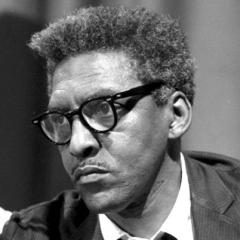
Bayard Rustin
Bayard Rustin

Bayard Rustin was a prominent African American civil rights activist who played a significant role in the American civil rights movement. He was a strategist and advisor to many civil rights leaders, including Martin Luther King Jr. Rustin was a key figure in the organization of the 1963 March on Washington for Jobs and Freedom, one of the largest political protests in U.S. history. He was also a leader in the gay rights movement and advocated for nonviolent protest and civil disobedience. more

You May Also Like

“Until this century, most of mankind lived in small communities. What each did could affect only a few others. But conditions have now changed. Each of us can now, in countless ways, affect countless other people. We can have real though small effects on thousands or millions of people. When these effects are widely dispersed, they may be either trivial, or imperceptible. It now makes a great difference whether we continue to believe that we cannot have greatly harmed or benefited others unless there are people with obvious grounds for resentment or gratitude.”

“It is a strange notion that the acknowledgment of a first principle is inconsistent with the admission of secondary ones. To inform a traveler respecting the place of his ultimate destination, is not to forbid the use of land-marks and direction-posts on the way. The proposition that happiness is the end and aim of morality, does not mean that no road ought to be laid down to that goal, or that persons going thither should not be advised to take one direction rather than another. Men really ought to leave off talking a kind of nonsense on this subject, which they would neither talk nor listen to on other matters of practical concernment. Nobody argues that the art of navigation is not founded on astronomy, because sailors cannot wait to calculate the Nautical Almanack. Being rational creatures, they go to sea with it ready calculated; and all rational creatures go out upon the sea of life with their minds made up on the common questions of right and wrong, as well as on many of the far more difficult questions of wise and foolish. And this, as long as foresight is a human quality, it is to be presumed they will continue to do. Whatever we adopt as the fundamental principle of morality, we require subordinate principles to apply it by: the impossibility of doing without them, being common to all systems, can afford no argument against any one in particular: but gravely to argue as if no such secondary principles could be had, and as if mankind had remained till now, and always must remain, without drawing any general conclusions from the experience of human life, is as high a pitch, I think, as absurdity has ever reached in philosophical controversy.”

“Pacifists have usually regarded the use of violence as absolutely wrong, irrespective of its consequences. This, like other ‘no matter what’ prohibitions, assumes the validity of the distinction between acts and omissions. Without this distinction, pacifists who refuse to use violence when it is the only means of preventing greater violence would be responsible for the greater violence they fail to prevent.”

“Inherent morality is like tying a hand behind our backs. Outcomes and methods exist in the moment, and may cause us personal fear, but what we must look at is the long-term consequences of our actions. Our human instinct is to demand inherent morality from fear for ourselves, but this shows us is that what we want to consider "inherent" to the world is inherent to a different globe entirely - the human head.”

“Today.” Cas reached between us, curling his fingers under my chin. He brought my gaze to his. “It turned midnight just as I arrived. April 20th. Your birthday.” (...) Cas smiled. Just one dimple was visible, and that surprise gave way to a sweet rise of love, so much love that it almost hurt for my heart to be so full of it. “You remembered,” I whispered. “Apparently, someone had to,” he teased, sweeping his thumb over my cheek. His eyes fixed on mine. “And I would never forget, Poppy. I will be with you for each and every birthday.”