Quotessence
Home / Quotes / Quote by Homer

Quote by Homer

“Sit still and wait for orders from your officers, who are better men than you, coward and weakling that you are, counting for nothing in battle or debate. We cannot all be kings here; and mob rule is a bad thing. Let there be one commander only, one king, set over us by Zeus the Son of Cronos of the Crooked Ways”

Quote by Homer

Work

The Iliad

An ancient Greek epic, The Iliad, narrates the events of the Trojan War, focusing on the conflict between the Greeks and the Trojans, particularly the story of the warrior Achilles. more

Author

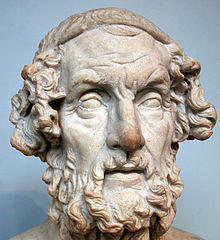
Homer
Homer

Homer, according to limited information, was an ancient Greek poet, credited with authorship of the epic poems 'The Iliad' and 'The Odyssey'. His biography is not well-documented, with the exact dates of his birth and death unknown. His works have had a profound impact on Western literature. more

You May Also Like

“Yet [the Crown's] electors could have no idea of giving hereditary right to his descendants, because such a perpetual exclusion of themselves was incompatible with the free and restrained principles they professed to live by. Wherefore, hereditary succession in the early ages of monarchy could not take place as a matter of claim, but as something casual or complemental; but as few or no records were extant in those days, the traditionary history stuff'd with fables, it was very easy, after the lapse of a few generations, to trump up some superstitious tale conveniently timed, Mahomet-like, to cram hereditary right down the throats of the vulgar. Perhaps the disorders which threatened, or seemed to threaten, on the decease of a leader and the choice of a new one (for elections among ruffians could not be very orderly) induced many at first to favour hereditary pretensions; by which means it happened, as it hath happened since, that what at first was submitted to as a convenience was afterwards claimed as a right.”

“Is the Lord’s Supper only for Christians? Whenever I ask this question I immediately remember the character of those that partook of the Last Supper with Jesus. They were certainly Jews, some better Jews than others, but Jesus shared this meal knowingly even with Judas. Or again consider the Emmaus Road encounter. Jesus shares this meal with those who had given up on his being the One to redeem Israel, who were leaving Jerusalem downcast and disappointed, and who were oblivious to the fact that it was Jesus who was speaking and sharing with them! There has to be a balance in the liturgy to help the congregation make a decision if they themselves are ready to partake of this Meal in a worthy manner (hence the 'ye who do truly and earnestly repent' clause), while at the same time joyfully welcoming all who are willing and ready and able to do so.”

“In the wake of the Reformation, as the correct reading of scripture became a matter of increasingly high stakes, Hebrew, as well as Aramaic, Samaritan, Ethiopian, Armenian, and other languages that preserved versions of scripture and documents of the early church, became essential weapons of theological warfare.”