Quotessence
Home / Quotes / Quote by Murray Gell-Mann

Quote by Murray Gell-Mann

“In 1963, when I assigned the name "quark" to the fundamental constituents of the nucleon, I had the sound first, without the spelling, which could have been "kwork." Then, in one of my occasional perusals of Finnegans Wake, by James Joyce, I came across the word "quark" in the phrase "Three quarks for Muster Mark." Since "quark" (meaning, for one thing, the cry of a gull) was clearly intended to rhyme with "Mark," as well as "bark" and other such words, I had to find an excuse to pronounce it as "kwork." But the book represents the dreams of a publican named Humphrey Chimpden Earwicker. Words in the text are typically drawn from several sources at once, like the "portmanteau words" in Through the Looking Glass. From time to time, phrases occur in the book that are partially determined by calls for drinks at the bar. I argued, therefore, that perhaps one of the multiple sources of the cry "Three quarks for Muster Mark" might be "Three quarts for Mister Mark," in which case the pronunciation "kwork" would not be totally unjustified. In any case, the number three fitted perfectly the way quarks occur in nature.”

Quote by Murray Gell-Mann

Work

The Quark and the Jaguar: Adventures in the Simple and the Complex

Browse quotes and source details for this work. more

Author
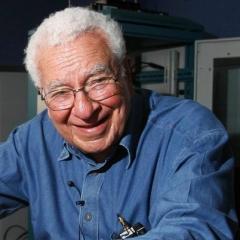
Murray Gell-Mann
Murray Gell-Mann

Murray Gell-Mann, born on September 15, 1929, is a renowned physicist. He made significant contributions to the field of particle physics, particularly with his proposal of the quark model, which has been crucial in understanding the structure of fundamental particles. more

You May Also Like

“Professional chefs aren't the only ones who get to wear an apron to work. There are welders and farriers and fishmongers and printers and grocery clerks and artists and florists and bakers and housekeepers and lab technicians and carpenters, to name a few who call an apron their uniform, and lucky them. How nice to be able to shift gears from leisure to work and back again with the tug of an apron string.”

“Mother's Apron There's a great old skit called "Mother's Apron" that touts the many household uses of the apron. This basic skit, with its infinite individual variations, has been performed by women's church and community clubs for generations. Below is a version remembered by Bernice Esau that was presented by her mother, probably originally in Low German, the common language of the rural Minnesota community where it was performed, hence the slightly lilting, old-fashioned sound to it: Do you remember Mother's aprons? Always big they were, and their uses were many. Besides the foremost purpose, the protection of the dress beneath, it was a holder for removal of hot pans from the oven. It was wonderful for drying children's tears and, yes, even for wiping small noses. From the henhouse it carried eggs, fuzzy chicks, ducklings, or goslings, and sometimes half-hatched eggs to be finished in the warming oven. Its folds provided an ideal hiding place for shy children, and when guests lingered on chilly days, the apron was wrapped about Mother's arms. Innumerable times it wiped a perspiring brow bent over a hot wood-burning stove. Corncobs and wood kindlings came to the kitchen stove in that ample garment, as did fresh peas and string beans from the garden. Often they were podded and stemmed in the lap the apron covered. Windfall apples were gathered in it, and wildflowers. Chairs were hastily dusted with its corners when unexpected company was sighted. Waving it aloft was as good as a dinner bell to call the men from the field. Big they were, and useful. Now I wonder, will any modern-day apron provoke such sweet and homesick memories?”

“The dust on his face now turning to mild streaks of mud, where his tears fell, made him seem like an operatic clown character in Pagliacci when he looked at the inscription for the first time. To Alexander, my son, you are our brightest star. Always remember the only future you are ever guaranteed is the one you make for yourself. Willpower, Wisdom and intelligence are the keys—Love Dad Upon reading the words in the ring Alex realized that when he lost in his mental battle. He had given into fate, in all its entropic nonsense. He let it dictate his world. He had surrendered in what he thought was a victory and left himself at the whimsical and incidental forces of chance.”

“Paralytic It happens. Will it go on? ---- My mind a rock, No fingers to grip, no tongue, My god the iron lung That loves me, pumps My two Dust bags in and out, Will not Let me relapse While the day outside glides by like ticker tape. The night brings violets, Tapestries of eyes, Lights, The soft anonymous Talkers: 'You all right?' The starched, inaccessible breast. Dead egg, I lie Whole On a whole world I cannot touch, At the white, tight Drum of my sleeping couch Photographs visit me ---- My wife, dead and flat, in 1920 furs, Mouth full of pearls, Two girls As flat as she, who whisper 'We're your daughters.' The still waters Wrap my lips, Eyes, nose and ears, A clear Cellophane I cannot crack. On my bare back I smile, a buddha, all Wants, desire Falling from me like rings Hugging their lights. The claw Of the magnolia, Drunk on its own scents, Asks nothing of life.”