Quotessence
Home / Quotes / Quote by Guy de Maupassant

Quote by Guy de Maupassant

“She was simple, not being able to adorn herself, but she was unhappy, as one out of her class; for women belong to no caste, no race, their grace, their beauty and their charm serving them in place of birth and family. Their inborn finesse, their instinctive elegance, their suppleness of wit, are their only aristocracy, making some daughters of the people the equal of great ladies.”

Quote by Guy de Maupassant

Work

A Piece of String / The Necklace

Browse quotes and source details for this work. more

Author
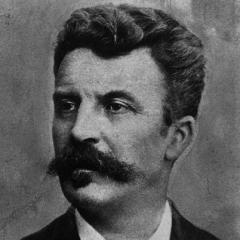
Guy de Maupassant
Guy de Maupassant

Guy de Maupassant, born on August 5, 1850 and died on July 6, 1893, was a renowned French novelist and master of the short story, often hailed as the 'King of Short Stories'. With his keen observation and unique writing style, Maupassant produced a vast array of short stories reflecting social realities and human weaknesses, which have had a profound impact on literature. more

You May Also Like

“There's one big difference between the poor and the rich,' Kite says, taking a drag from his cigarette. We are in a pub, at lunch-time. John Kite is always, unless stated otherwise, smoking a fag, in a pub, at lunch-time. 'The rich aren't evil, as so many of my brothers would tell you. I've known rich people -- I have played on their yachts -- and they are not unkind, or malign, and they do not hate the poor, as many would tell you. And they are not stupid -- or at least, not any more than the poor are. Much as I find amusing the idea of a ruling class of honking toffs, unable to put their socks on without Nanny helping them, it is not true. They build banks, and broker deals, and formulate policy, all with perfect competency. 'No -- the big difference between the rich and the poor is that the rich are blithe. They believe nothing can ever really be so bad, They are born with the lovely, velvety coating of blitheness -- like lanugo, on a baby -- and it is never rubbed off by a bill that can't be paid; a child that can't be educated; a home that must be left for a hostel, when the rent becomes too much. 'Their lives are the same for generations. There is no social upheaval that will really affect them. If you're comfortably middle-class, what's the worst a government policy could do? Ever? Tax you at 90 per cent and leave your bins, unemptied, on the pavement. But you and everyone you know will continue to drink wine -- but maybe cheaper -- go on holiday -- but somewhere nearer -- and pay off your mortgage -- although maybe later. 'Consider, now, then, the poor. What's the worst a government policy can do to them? It can cancel their operation, with no recourse to private care. It can run down their school -- with no escape route to a prep. It can have you out of your house and into a B&B by the end of the year. When the middle-classes get passionate about politics, they're arguing about their treats -- their tax breaks and their investments. When the poor get passionate about politics, they're fighting for their lives. 'Politics will always mean more to the poor. Always. That's why we strike and march, and despair when our young say they won't vote. That's why the poor are seen as more vital, and animalistic. No classical music for us -- no walking around National Trust properties, or buying reclaimed flooring. We don't have nostalgia. We don't do yesterday. We can't bear it. We don't want to be reminded of our past, because it was awful; dying in mines, and slums, without literacy, or the vote. Without dignity. It was all so desperate, then. That's why the present and the future is for the poor -- that's the place in time for us: surviving now, hoping for better, later. We live now -- for our instant, hot, fast treats, to prep us up: sugar, a cigarette, a new fast song on the radio. 'You must never, never forget, when you talk to someone poor, that it takes ten times the effort to get anywhere from a bad postcode, It's a miracle when someone from a bad postcode gets anywhere, son. A miracle they do anything at all.”

“Maintaining connections with family and community across class boundaries demands more than just summary recall of where one’s roots are, where one comes from. It requires knowing, naming, and being ever-mindful of those aspects of one’s past that have enabled and do enable one’s self-development in the present, that sustain and support, that enrich. One must also honestly confront barriers that do exist, aspects of that past that do diminish.”

“Wait, wait,' he began, interrupting Oblonsky. 'Aristocratism, you say. But allow me to ask, what makes up this aristocratism of Vronsky or whoever else it may be - such aristocratism that I can be scorned? You consider Vronsky an aristocrat, but I don't. A man whose father crept out of nothing by wiliness, whose mother, God knows who she didn't have liaisons with... No, excuse me, but I consider myself an aristocrat and people like myself, who can point to three or four honest generations in their families' past, who had a high degree of education (talent and intelligence are another thing), and who never lowered themselves before anyone, never depended on anyone, as my father lived, and my grandfather. And I know many like that. You find it mean that I count the trees in the forest, while you give away thirty thousand to Ryabinin; but you'll have rent coming in and I don't know what else, while I won't, and so I value what I've inherited and worked for... We're the aristocrats, and not someone who can only exist on hand-outs from the mighty of this world and can be bought for twenty kopecks. 'But who are you attacking? I agree with you,' said Stepan Arkadyich sincerely and cheerfully, though he felt Levin included him among those who could be bought for twenty kopecks.”

“Take a little thought experiment. Imagine all the rampage school shooters in Littleton, Colorado; Pearl, Mississippi; Paducah, Kentucky; Springfield, Oregon; and Jonesboro, Arkansas; now imagine they were black girls from poor families who lived instead in Chicago, New Haven, Newark, Philadelphia, or Providence. Can you picture the national debate, the headlines, the hand-wringing? There is no doubt we’d be having a national debate about inner-city poor black girls. The entire focus would be on race, class, and gender. The media would doubtless invent a new term for their behavior, as with wilding two decades ago. We’d hear about the culture of poverty, about how living in the city breeds crime and violence. We’d hear some pundits proclaim some putative natural tendency among blacks toward violence. Someone would likely even blame feminism for causing girls to become violent in a vain imitation of boys. Yet the obvious fact that virtually all the rampage school shooters were middle-class white boys barely broke a ripple in the torrent of public discussion. This uniformity cut across all other differences among the shooters: some came from intact families, others from single-parent homes; some boys had acted violently in the past, and others were quiet and unassuming; some boys also expressed rage at their parents (two killed their parents the same morning), and others seemed to live in happy families.”

“All the golden societies of the past to which historians point and turn their wistful smiles have had what patience-players would call a discard pile. They operated on two levels with a slave class who worked, ate, slept, and died and a leisured class who reclined on one elbow and spoke. Naturally it is from this latter group that we learn what life at that time was like. It often makes charming reading but we can hardly take it to be the whole truth.”

“Rich people don’t have to have a life-and-death relationship with the truth and its questions; they can ignore the truth and still thrive materially. I am not surprised many of them understand literature only as an ornament. Life is an ornament to them, relationships are ornaments, their 'work' is but a flimsy, pretty ornament meant to momentarily thrill and capture attention.”