Quotessence
Home / Quotes / Quote by Bell Hooks

Quote by Bell Hooks

“Maintaining connections with family and community across class boundaries demands more than just summary recall of where one’s roots are, where one comes from. It requires knowing, naming, and being ever-mindful of those aspects of one’s past that have enabled and do enable one’s self-development in the present, that sustain and support, that enrich. One must also honestly confront barriers that do exist, aspects of that past that do diminish.”

Quote by Bell Hooks

Work

Talking Back: Thinking Feminist, Thinking Black

This book delves into the complex relationship between feminism and black culture, examining the unique challenges and experiences faced by black women. It features essays that discuss race, gender, and social justice, offering insights into the ongoing dialogue surrounding these issues. more

Author
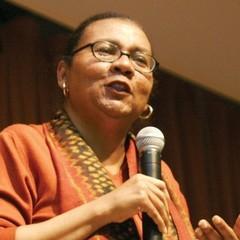
Bell Hooks
Bell Hooks

Bell Hooks, born Gloria Jean Watkins, is an American author, scholar, and activist. Her work primarily focuses on issues of race, gender, and social justice, particularly on feminist and black feminist thought. Hooks' works include novels, poetry, academic writings, and autobiographies, and her writing style is beloved by readers for its profound social insight and desire for change. more

You May Also Like

“Wait, wait,' he began, interrupting Oblonsky. 'Aristocratism, you say. But allow me to ask, what makes up this aristocratism of Vronsky or whoever else it may be - such aristocratism that I can be scorned? You consider Vronsky an aristocrat, but I don't. A man whose father crept out of nothing by wiliness, whose mother, God knows who she didn't have liaisons with... No, excuse me, but I consider myself an aristocrat and people like myself, who can point to three or four honest generations in their families' past, who had a high degree of education (talent and intelligence are another thing), and who never lowered themselves before anyone, never depended on anyone, as my father lived, and my grandfather. And I know many like that. You find it mean that I count the trees in the forest, while you give away thirty thousand to Ryabinin; but you'll have rent coming in and I don't know what else, while I won't, and so I value what I've inherited and worked for... We're the aristocrats, and not someone who can only exist on hand-outs from the mighty of this world and can be bought for twenty kopecks. 'But who are you attacking? I agree with you,' said Stepan Arkadyich sincerely and cheerfully, though he felt Levin included him among those who could be bought for twenty kopecks.”

“Take a little thought experiment. Imagine all the rampage school shooters in Littleton, Colorado; Pearl, Mississippi; Paducah, Kentucky; Springfield, Oregon; and Jonesboro, Arkansas; now imagine they were black girls from poor families who lived instead in Chicago, New Haven, Newark, Philadelphia, or Providence. Can you picture the national debate, the headlines, the hand-wringing? There is no doubt we’d be having a national debate about inner-city poor black girls. The entire focus would be on race, class, and gender. The media would doubtless invent a new term for their behavior, as with wilding two decades ago. We’d hear about the culture of poverty, about how living in the city breeds crime and violence. We’d hear some pundits proclaim some putative natural tendency among blacks toward violence. Someone would likely even blame feminism for causing girls to become violent in a vain imitation of boys. Yet the obvious fact that virtually all the rampage school shooters were middle-class white boys barely broke a ripple in the torrent of public discussion. This uniformity cut across all other differences among the shooters: some came from intact families, others from single-parent homes; some boys had acted violently in the past, and others were quiet and unassuming; some boys also expressed rage at their parents (two killed their parents the same morning), and others seemed to live in happy families.”

“All the golden societies of the past to which historians point and turn their wistful smiles have had what patience-players would call a discard pile. They operated on two levels with a slave class who worked, ate, slept, and died and a leisured class who reclined on one elbow and spoke. Naturally it is from this latter group that we learn what life at that time was like. It often makes charming reading but we can hardly take it to be the whole truth.”

“Rich people don’t have to have a life-and-death relationship with the truth and its questions; they can ignore the truth and still thrive materially. I am not surprised many of them understand literature only as an ornament. Life is an ornament to them, relationships are ornaments, their 'work' is but a flimsy, pretty ornament meant to momentarily thrill and capture attention.”

“She's on the stairs, ma'am, getting her breath,' said the young servant, who had not been long up from the country, where my mother had the excellent habit of getting all her servants. Often she had seen them born. That's the only way to get really good ones. And they're the rarest of luxuries.”

“Takamasa Saegusa: 'Seigen, a mere member of the Toudouza, had the effrontery to sully the sacred dueling ground. For that reason, our lord had already decided to subject him to tu-uchi before long. Cut off his head immediately, and stick it on a pike!' Gennosuke could hardly believe his ears. Such an insult to Irako Seigen was unwarranted. It was pride. For Gennosuke, Irako Seigen was pride itself. Takamasa Saegusa: 'Fujiki Gennosuke! It is the way of the samurai to take the head of the defeated enemy on the battleground. Do not hesitate! If you are a samurai, you must carry out the duty of a samurai!' Samurai... Saegusa, Lord of Izu, continued shouting, but Gennosuke did not attend. That word 'samurai' alone reverberated through his body. If one aims at the juncture between the base of the skull and the spine, decapitation is not that difficult, but Gennosuke could muster no more strength than a baby. He grew pale and trembled with the strain. He could only hack with his sword as if he were sawing wood. He felt nauseated, as if his own cells one after another were being annihilated. But this... Lord Tokugawa Tadanaga: 'I approve.' Takamasa Saegusa: 'Fujiki Gennosuke, for this splendid action you have received words of thanks from our lord. As a sign of his exceptional approval, you shall be given employment at Sunpu Castle. This great debt will by no means be forgotten. From this day forward you must offer your life to our lord!' Prostrating himself, Gennosuke vomited.”

“You had to have these peasant leaders quickly in this sort of war and a real peasant leader might be a little too much like Pablo. You couldn't wait for the real Peasant Leader to arrive and he might have too many peasant characteristics when he did. So you had to manifacture one. At that, from what he had seen of Campesino, with his black beard, his thick negroid lips, and his feverish, staring eyes, he thought he might give almost as much trouble as a real peasant leader. The last time he had seen him he seemed to have gotten to believe his own publicity and think he was a peasant.”