Quotessence
Home / Quotes / Quote by Snorri Sturluson

Quote by Snorri Sturluson

Work

The Prose Edda: Norse Mythology

Browse quotes and source details for this work. more

Author
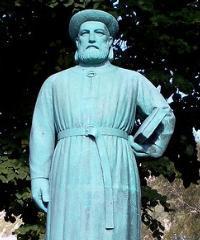
Snorri Sturluson
Snorri Sturluson

Snorri Sturluson was an Icelandic historian, considered one of the greatest writers of the North. He was born in 1179 and died on September 23, 1241. Snorri is renowned for his compilation of Icelandic and Norse history, particularly for his works 'Icelandic Kings' Sagas' and 'Edda'. more

You May Also Like

“I don't know where the idea of Vikings having horns on their helmets came from, but it's a brilliant one. In every possible way, other than the literal truth, they totally had horns on their helmets. Horned helmets was absolutely their vibe and I feel we all have a right to that deeper artistic truth. They had limited technology and manufacturing helmets was pretty tricky for them, I imagine, so putting horns on them wouldn't have been workable, and wouldn't ave increased the functionality of the helmets, but I swear they'd have given it a go if they'd thought of it.”

“The Vikings thought they were big shots because they had boats. You know how obnoxious people get when they own a boat. They always want to go on the boat. "We're taking the boat out this weekend. It's supposed to be beautiful. Why don't you come? You never come. You're always working. You know how many people wish they would get invited to come on the boat? And you turn it down.”

“Even in terms of fiction, nothing in their lives became them like the leaving of it. King Fjolnir rose in the night to make water, fell into a vat of mead and drowned instead; Sveigdir ran after a dwarf when drunk and vanished into a boulder; Vanlandi was trampled to death by a nightmare; Domaldi was sacrificed for good seasons; Dag was struck on the head with a pitchfork when seeking revenge for his sparrow; and so on down to the fifth century.”

“Thousands of year ago, a Viking warrior was laid to rest in a grave adorned with a sword, an axe, a spear, armor piercing arrows, a battle knife, two shields, and two horses, all suggestive of a professional, high-ranking commander. When the grave was discovered in the late nineteenth century, experts agreed this must be the burial site of an esteemed MALE warrior. It wasn't until the 1970s that some scientists looked more closely at the remains and asked: Could these small, gracile bones be the remains of a woman? The greater scientific community balked; the very idea of a female warrior was too ridiculous to entertain. And yet, fifty years later, a DNA analysis of the Viking skeleton by Stockholm Unversity osteologist Anna Kjellstrom conclusively proved it accurate. It only took so long, and required so much, because the bones told a different story than the medical institions and experts of the 1800s did. The skeleton was clearly female - but the men saw what they wished to see, what they'd been taught to see.”

“These great Nordic incursions were to result in the marginalization of the once semi-autonomous Pictish, English and North British Princedoms that had preceded the arrival of the Norsemen on British soil. And, as they disappeared beneath the onslaught of the Viking Hosts, the ancient bardic traditions, which had once been succoured by these previously distinct ethnic groups, gradually became intertwined with one another as a result of widespread migration, inter-marriage and cross fertilization; the ultimate legacy of which was the perpetuation of the fragmentary remains of the ancient traditions which were to come to adorn the ballads that the Laird of Abbotsford himself collected, amongst the eighteenth century descendants of these ancient peoples.”