Quotessence
Home / Quotes / Quote by Gustave Flaubert

Quote by Gustave Flaubert

“An overwhelming curiosity makes me ask myself what their lives might be like. I want to know what they do, where they're from, their names, what they're thinking about at that moment, what they regret, what they hope for, their past loves, their current dreams ... and if they happen to be women (especially the young ones) then the urge becomes intense. How quickly would you want to see her naked, admit it, and naked through to her heart. How you try to learn where she comes from, where she's going, why she's here and not elsewhere! While letting your eyes wander all over her, you imagine love affairs for her, you ascribe her deep feelings. You think of the bedroom she must have, and a thousand things besides ... right down to the battered slippers into which she must slip her feet when she gets out of bed.”

Quote by Gustave Flaubert

Author
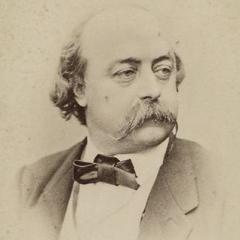
Gustave Flaubert
Gustave Flaubert

Gustave Flaubert, born on December 12, 1821 and died on May 8, 1880, was a prominent French writer of the 19th century. Known for his exquisite literary skills and profound psychological portrayals, Flaubert is best remembered for his masterpiece 'Madame Bovary'. more

You May Also Like

“Indeed, for my own part, though I have been repeatedly told by persons for whom I have the greatest respect, that Miss Brown is an insignificant chit, and Mrs. White has nothing but her petit minois chiffonne, and Mrs. Black has not a word to say for herself; yet I know that I have had the most delightful conversations with Mrs. Black (of course, my dear Madam, they are inviolable): I see all the men in a cluster round Mrs. White's chair: all the young fellows battling to dance with Miss Brown; and so I am tempted to think that to be despised by her sex is a very great compliment to a woman.”

“There's no being out too late in Whileaway, or up too early, or in the wrong part of town, or unescorted. You cannot fall out of the kinship web and become sexual prey for strangers, for there is no prey and there are no strangers -- the web is world-wide. In all of Whileaway there is no one who can keep you from going where you please (though you may risk your life, if that sort of thing appeals to you), no one who will follow you and try to embarrass you by whispering obscenities in your ear, no one who will attempt to rape you, no one who will warn you of the dangers of the street, no one who will stand on street corners, hot-eyed and vicious, jingling loose change in his pants pocket, bitterly bitterly sure that you're a cheap floozy, hot and wild, who likes it, who can't say no, who's making a mint off it, who inspires him with nothing but disgust, and who wants to drive him crazy.”

“She's a bright girl. She learned in her thirteenth year that you can get old films of Mae West or Marlene Dietrich (who is a Vulcan; look at the eyebrows) after midnight on UHF if you know where to look, at fourteen that pot helps, at fifteen that reading's even better. She learned, wearing her rimless glasses, that the world is full of intelligent, attractive, talented women who manage to combine careers with their primary responsibilities as wives and mothers and whose husbands beat them. She's put a gold circle pin on her shirt as a concession to club day. She loves her father and once is enough. Everyone knows that much as women want to be scientists and engineers, they want foremost to be womanly companions to men (what?) and caretakers of childhood; everyone knows that a large part of a woman's identity inheres in the style of her attractiveness. Laur is daydreaming. She looks straight before her, blushes, smiles, and doesn't see a thing... Laur is daydreaming that she's Genghis Khan.”

“The best I can say, it's like this. A man's in his skin, see, like a nut in its shell ... It's hard and strong, that shell, and it's all full of him. Full of grand man-meat, man-self. And that's all. That's all there is. A woman's a different thing entirely. Who knows where a woman begins and ends? Listen mistress, I have roots, I have roots deeper than this island. Deeper than the sea, older than the raising of the lands. I go back into the dark ... I go back into the dark! Before the moon I am, what a woman is, a woman of power, a woman's power, deeper than the roots of trees, deeper than the roots of islands, older than the Making, older than the moon. Who dares ask questions of the dark? Who'll ask the dark its name?”

“What did you spend so much time talking about with Ila? If you weren’t dancing with that long-legged fellow, you were talking to her like it was some kind of secret.” “Ila was giving me advice on being a woman,” Egwene replied absently. He began laughing, and she gave him a hooded, dangerous look that he failed to see. “Advice! Nobody tells us how to be men. We just are.” “That,” Egwene said, “is probably why you make such a bad job of it.”

“A society without the authentic and vibrant influence of women is a society that is not fully alive. A culture lacking the vital creativity of women is disadvantaged. Without the bearing of women on world affairs, humanity's already tenuous grip on peace is made even less sure. When women are barred, whether by law, cultural prejudice, or political ideology, from developing their full potential and offering their unique gifts, it is an injustice to women themselves and to humanity as a whole.”