Quotessence
Home / Quotes / Quote by Friedrich Nietzsche

Quote by Friedrich Nietzsche

Work

Thus Spoke Zarathustra

Thus Spoke Zarathustra is a philosophical novel that delves into profound themes such as the will to power, the eternal recurrence, and the concept of the Übermensch. The book is a collection of aphorisms and dialogues narrated by the character Zarathustra, who seeks to inspire others to embrace life and strive for self-overcoming. Written by the German philosopher Friedrich Nietzsche, the work is considered a cornerstone of modern Western philosophy. more

Author
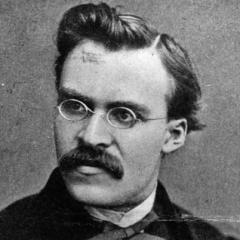
Friedrich Nietzsche
Friedrich Nietzsche

Friedrich Nietzsche was a German philosopher, cultural critic, poet, and writer whose works have had a profound impact on subsequent philosophy, literature, and thought. His ideas revolve around concepts such as the 'will to power', the 'Übermensch', and the 'eternal recurrence'. more

You May Also Like

“We may be comfortably living in our apartments or houses. We may not be getting affected by hunger during this time of despair. But there are so many people out there who may not have a proper meal in the last few days. The turmoil caused by the COVID 19 pandemic is playing havoc in the lives of millions of people from all around the world. We are all in this together. We all can do our bit Let's feed the hungry and help the less fortunate among us. Together we can make the world a better place.”

“Melanie had the face of a sheltered child who had never known anything but simplicity and kindness, truth and love, a child who had never looked upon harshness or evil and would not recognize them if she saw them. Because she had always been happy, she wanted everyone about her to be happy or, at least, pleased with themselves. To this end, she always saw the best in everyone and remarked kindly upon it. There was no servant so stupid that she did not find some redeeming trait of loyalty and kind heartedness, no girl so ugly and disagreeable that she could not discover grace of form or nobility of character in her, and no man so worthless or so boring that she did not view him in the light of his possibilities rather than his actualities. Because of these qualities that came sincerely and spontaneously from a generous heart, everyone flocked about her, for who can resist the charm of one who discovers in others admirable qualities undreamed of even by himself? She had more girl friends than anyone in town and more men friends too, though she had few beaux for she lacked the willfulness and selfishness that go far toward trapping men's hearts. What Melanie did was no more than all Southern girls were taught to do-to make those about them feel at ease and pleased with themselves. It was this happy feminine conspiracy which made Southern society so pleasant. Women knew that a land where men were contented, uncontradicted and safe in possession of unpunctured vanity was likely to be a very pleasant place for women to live. So, from the cradle to the grave, women strove to make men pleased with themselves, and the satisfied men repaid lavishly with gallantry and adoration. In fact, men willingly gave the ladies everything in the world except credit for having intelligence. Scarlett exercised the same charms as Melanie but with a studied artistry and consummate skill. The difference between the two girls lay in the fact that Melanie spoke kind and flattering words from a desire to make people happy, if only temporarily, and Scarlett never did it except to further her own aims.”

“Ain't Good People (The Sonnet) Ain't no good people we, If goodness means blindness. Ain't no practical folks we, If practicality means selfishness. Ain't no sane citizens we, If sanity means indifference. Ain't no smart bunch we, If smartness brings arrogance. Ain't no articulate minds we, If articulation means mindless accuracy. Ain't no civilized society we, If civilization means hypocrisy. We are the force capable of mastering a planet. Let's live not as machines but conscience incarnate.”

“When you see that you're making other things feel good, it gives you a good feeling, too. The feeling inside sort of just happens, and you can't say this did it or that did it. It's the many little things. It doesn't seem that taking sweat-soaked harnesses off tired, hot horses would be something that would make you notice. Opening a barn door for the sheep standing out in a cold rain, or throwing a few grains of corn to the chickens are small things, but these little things begin to add up in you, and you can begin to understand that you're important. You may not be real important like people who do great things that you read about in the newspaper, but you begin to feel that you're important to all the life around you. Nobody else knows or cares too much about what you do, but if you get a good feeling inside about what you do, then it doesn't matter if nobody else knows. I do think about myself a lot when I'm alone way back on the place bringing in the cows or sitting on a mowing machine all day. But when I start thinking about how our animals and crops and fields and woods and gardens sort of all fit together, I then get that good feeling inside and don't worry much about what will happen to me.”