Quotessence
Home / Quotes / Quote by Pope Paul VI

Quote by Pope Paul VI

“Look down with maternal clemency, Most Blessed Virgin, upon all your children. Consider the anxiety of bishops who fear their flocks will be tormented by a terrible storm of evils. Heed the anguish of so many people, fathers and mothers of families who are uncertain about their future and beset by hardship and cares. (Christi Matri Rosarii)”

Quote by Pope Paul VI

Author
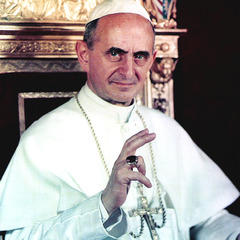
Pope Paul VI
Pope Paul VI

Pope Paul VI, born Giuseppe Montini, was the 262nd Pope of the Roman Catholic Church, serving from 1963 to 1978. His pontificate witnessed several significant reforms, including the implementation of the Second Vatican Council. more

You May Also Like

“The theology of the messages is profoundly Catholic. The Blessed Virgin Mary, Mother of God, is revealed as the Mediatrix of all graces. So prominent is She in Heaven's designs that "the justice of God condemns" those who commit sins against Her. Moreover, She is authorized to promise salvation to those who practice the First Five Saturdays reparatory devotion. Devotion to her Immaculate Heart is given as the signal remedy to reduce the number of souls who are damning themselves to hell. In the vision at Tuy Mary stands at the foot of the Cross, Her Immaculate Heart crowned with thorns and bursting with flames. The striking image emphasizes Mary's role as Co-redemptrix of mankind.”

“I believe that it is dangerous for a young person simply to go from achieving goal after goal, generally being praised along the way. So it is good for a young person to experience his limit, occasionally to be dealt with critically, to suffer his way through a period of negativity, to recognise his own limits himself, not simply to win victory after victory. A human being needs to endure something in order to learn to assess himself correctly, and not least to learn to think with others. Then he will not simply judge others hastily and stay aloof, but rather accept them positively, in his labours and his weaknesses.”

“Pope Benedict XVI on Pope St Paul VI: Let us pay homage to the spirit of evangelical wisdom with which my beloved predecessor was able to guide the Church during and after the Second Vatican Council. With prophetic intuition he perceived the hopes and anxieties or the people at that time; he strove to make the most of the positive experiences, seeking to illuminate them with the light of truth and the love of Christ.”

“One imagines that similar scenes of joy erupted throughout the world wherever two or three faithful Catholics gathered together. In contrast, the election of Ratzinger was greeted with grief and horror by those heretical theologians and cafeteria Catholics whose heresies and backsliding equivocations had been condemned by the new Pope during his many years as Prefect of the Congregation for the Doctrine of the Faith. As usual, these wolves in sheep’s clothing howled in unison with the wolves in the secular media, uniting themselves with the avowed enemies of the Church in their hatred of the hero of orthodoxy who had forced them into retreat during his years as John Paul II’s faithful and fearless servant. In the war of words that followed the Pope’s election, the enemies of orthodoxy decried the new German shepherd as “God’s Rottweiler.” Although the gentle and saintly Ratzinger did not deserve such an epithet, it is ironically apt that the wolves who would devour the flock should hate the Rottweiler who had courageously stopped them from doing so!”

“It had been a simpler time, when she could run carefree around the bailey, pretending to slay dragons and capture magical wisps. A time when she did not have to worry about betrothals, peace alliances, or any of the other duties she was now being forced to contend with as princess. But she would not have to worry about these duties for long. After Merida taught her how to survive the journey to Northumbria, she would have the freedom to study the region's fascinating artwork and listen to the poets who recited sonnets day in and day out. The freedom to spend her mornings tending to lost or injured animals, and her evenings singing folk songs with all the like-minded new friends she would meet.”

“I know of no part of Scotland so much and so visibly improved within thirty years as Aberdeenshire. At the beginning of that time the country between Keith and Stonehaven was little else than a hopeless region of stones and moss. There were pieces of many miles where literally there was nothing but large white stones, of from half a ton to ten tons weight, to be seen. A stranger to the character of the people would have supposed that despair would have held back their hands from even attempting to remove them. However, they began, and year after year have been going on, making dykes and drains, and filling up holes with these materials till at last they have created a country which, when the rain happens to cease and the sun shines, is really very endurable.”

“In nineteenth century Aberdeenshire farm service was not a career in itself, but a stage in a career that began for almost all in family farming, and would end there for a proportion of servants. Even in the middle of the century enough folk rode what Leslie Mitchell later would call the 'strange, antique whirlimagig of the Scottish peasantry' to ensure that the machine kept spinning. William Alexander called his essay on farm service "The Peasantry of North-East Scotland" because in his time English hired farm workers were conventionally - though incorrectly - described as peasants. But the error conceals a deeper truth. Aberdeenshire farm-servants, crofters, and small farmers were three fragments of a single peasant class.”