Quotessence
Home / Quotes / Quote by Thomas More

Quote by Thomas More

“but in Utopia, where every man has a right to everything, they all know that if care is taken to keep the public stores full no private man can want anything; for among them there is no unequal distribution, so that no man is poor, none in necessity, and though no man has anything, yet they are all rich; for what can make a man so rich as to lead a serene and cheerful life, free from anxieties; neither apprehending want himself, nor vexed with the endless complaints of his wife?”

Quote by Thomas More

Book:Utopia

Work

Utopia

Written by Sir Thomas More, this book presents a fictional island society that serves as a model for an ideal community, examining political, social, and religious aspects of life. more

Author

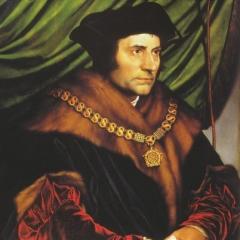
Thomas More
Thomas More

Thomas More, born on February 7, 1478, in London, England, and died on July 6, 1535. He was a renowned humanist, politician, philosopher, and writer in the English Renaissance, best known for his work 'Utopia'. During the reign of Henry VIII, More held several important positions, including Lord Chancellor and Chancellor of the Exchequer. His political ideas and social ideals have had a profound impact on the world. more

You May Also Like

“I get depressed with these fluffy dragons and noble elves. Elves were never noble. They were cruel bastards. And I dislike heroes. You can’t trust the buggers. They always let you down. I don’t believe in the natural nobility of kings, because a large percentage of them in our history have turned out to be power-crazed idiots. And I certainly don’t believe in the wisdom of wizards. I’ve worked with their modern equivalents, and I know what I’m talking about.”

“The ironic fact is that humanism which began with man's being central eventually had no real meaning for people. On the other hand, if one begins with the Bible's position that man is created by God and in the image of God, there is a basis for that person's dignity.”

“It is becoming fashionable to scorn the idea of sin in society. The impact of humanistic thinking is to belittle the concept that man is corrupt. Psychologists and psychiatrists would persuade us that people really are not responsible for their wrongs. Rather, the view of sociologists is that the environment is all wrong. Their cry is, 'Change society and you will get better men and women'. It simply does not happen. Christ's call is, 'Change men and women and you will get a better society'. This does work. It always has.”

“...if pride, that plague of human nature, that source of so much misery, did not hinder it; for this vice does not measure happiness so much by its own conveniences, as by the misery of others; and would not be satisfied with being thought a goddess, if none were left that were miserable, over whom she might insult. Pride thinks its own happiness shines the brighter, by comparing it with the misfortunes of other persons; that by displaying its own wealth they may feel their poverty the more sensibly.”

“but in Utopia, where every man has a right to everything, they all know that if care is taken to keep the public stores full no private man can want anything; for among them there is no unequal distribution, so that no man is poor, none in necessity, and though no man has anything, yet they are all rich; for what can make a man so rich as to lead a serene and chreerful life, free from anxieties; neither apprehending want himself, nor vexed with the endless complaints of his wife?”

“The First Mobile, if one is sent, must be warned that unless he is very self-assured, or senile, his pride will suffer. A man wants his virility regarded, a woman wants her femininity appreciated, however indirect and subtle the indications of regard and appreciation. On Winter they will not exist. One is respected and judged only as a human being. It is an appalling experience.”