Quotessence
Home / Quotes / Quote by Bayard Rustin

Quote by Bayard Rustin

“If administration actions are not to mock its own rhetoric, the President must now take the lead in mobilizing public opinion behind a new resolve to meet the crisis in our cities. He should now put before Congress a National Emergency Public Works and Reconstruction bill aimed at building housing for homeless victims of the riot-torn ghettos, repairing damaged public facilities, and in the process generating maximum employment opportunities for unskilled and semiskilled workers. Such a bill should be the first step in the imperative reconstruction of all our decaying center cities. Admittedly, the prospects for passage of such a bill in the present Congress are dismal. Congressmen will cry out that the rioters must not be re-warded, thereby further penalizing the very victims of the riots. This, after all, is a Congress capable of defeating a meager $40 million rat extermination program the same week it votes $10 million for an aquarium in the District of Columbia! But the vindictive racial meanness that has descended upon this Congress, already dominated by the revived coalition of Republicans and Dixiecrats, must be challenged—not accommodated. The President must go directly to the people, as Harry Truman did in 1948. He must go to them, not with slogans, but with a timetable for tearing down every slum in the country. There can be no further delay. The daydreamers and utopians are not those of us who have prepared massive Freedom Budgets and similar programs. They are the smugly "practical" and myopic philistines in the Congress, the state legislatures, and the city halls who thought they could sit it out. The very practical choice now before them and the American people is whether we shall have a conscious and authentic democratic social revolution or more tragic and futile riots that tear our nation to shreds.”

Quote by Bayard Rustin

Work

Down the Line: The Collected Writings of Bayard Rustin

Browse quotes and source details for this work. more

Author
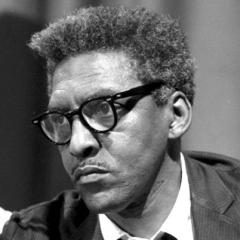
Bayard Rustin
Bayard Rustin

Bayard Rustin was a prominent African American civil rights activist who played a significant role in the American civil rights movement. He was a strategist and advisor to many civil rights leaders, including Martin Luther King Jr. Rustin was a key figure in the organization of the 1963 March on Washington for Jobs and Freedom, one of the largest political protests in U.S. history. He was also a leader in the gay rights movement and advocated for nonviolent protest and civil disobedience. more

You May Also Like

“It follows that the one thing we should not do to the men and women of past time, and particularly if they ghost through to us as larger than life, is to take them out of their historical contexts. To do so is to run the risk of turning them into monsters, whom we can denounce for our (frequently political) motives—an insidious game, because we are condemning in their make-up that which is likely to belong to a whole social world, the world that helped to fashion them and that is deviously reflected or distorted in them. Censure of this sort is the work of petty moralists and propagandists, not historians (p. 5).”

“The assumptions that propagandists are rational, in the sense that they follow their own propaganda theories in their choice of communications, and that the meanings of propagandists' communications may differ for different people reoriented the FCC* analysts from a concept of "content as shared" (Berelson would later say "manifest") to conditions that could explain the motivations of particular communicators and the interests they might serve. The notion of "preparatory propaganda" became an especially useful key for the analysts in their effort to infer the intents of broadcasts with political content. In order to ensure popular support for planned military actions, the Axis leaders had to inform; emotionally arouse, and otherwise prepare their countrymen and women to accept those actions; the FCC analysts discovered that they could learn a great deal about the enemy's intended actions by recognizing such preparatory efforts in the domestic press and broadcasts. They were able to predict several major military and political campaigns and to assess Nazi elites' perceptions of their situation, political changes within the Nazi governing group, and shifts in relations among Axis countries. Among the more outstanding predictions that British analysts were able to make was the date of deployment of German V weapons against Great Britain. The analysts monitored the speeches delivered by Nazi propagandist Joseph Goebbels and inferred from the content of those speeches what had interfered with the weapons' production and when. They then used this information to predict the launch date of the weapons, and their prediction was accurate within a few weeks. *FCC - Federal Communications Commission”

“Anti-Semitism was, of course, the Nazis' cleverest -- because most effective -- psychological stroke. Moreover, the leaders and forerunners of Nazism really believed in it -- for we must not imagine that any propaganda line will ever make headway unless its early spokesmen are themselves convinced of its truth. All political extremists mean what they say and shout. All of them, on both right and left, will carry out what they have promised in their wildest proclamations. For if they ranted only to win votes, or out of pure calculation, they would never be able to incite the masses to fanaticism. That is a truism we have learned through many painful lessons.”

“The summary of Lambert and Lillenfelt’s “Bloodstains” in Scientific American Mind in the October 12, 2007 The Informed Reader passes along many of these authors’ strong opinions on complex and controversial topics without informing the readership that the authors’ perspective is extreme, polarized, and vulnerable to challenge at many crucial points. It is clear that false memories can be implanted in about 25% of subjects, when those memories concern issues in the normal and expectable range of experience. However, about 75% of subjects resist such efforts, and efforts to implant memories of abuse or offensive medical procedures are almost universally rejected. Therefore a wholesale attack against therapies that explore patients’ memories is unwarranted. “Recovered Memory Therapy” is not a school of treatment. It is a slur used to mischaracterize approaches offensive to the authors’ perspectives, designed to evoke an emotional bias against those to whom the slur is applied.”

“[In a] recent PubMed and PsychAbstracts search... as we could not find a single reference for recovered memory therapy apart from those writing about its dangers. Our experience suggests that an overwhelming majority of clinicians do not assume or suggest to clients that they must have buried traumas from their past. It is also our experience that most clinicians are careful not to assume the literal veracity of reported traumatic memories, whether newly remembered or not." Cameron, C., & Heber, A. (2006). Re: Troubles in Traumatology, and Debunking Myths about Trauma and Memory/Reply: Troubles in Traumatology and Debunking Myths about Trauma and Memory. Canadian journal of psychiatry, 51(6), 402.”