Quotessence
Home / Quotes / Quote by Sun Tzu

Quote by Sun Tzu

Work

The Art of War

This seminal work explores the principles of warfare, leadership, and conflict resolution, offering timeless insights into the nature of power and the art of winning battles without resorting to brute force. more
Author

Sun Tzu
Sun Tzu

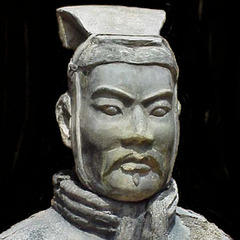
Sun Tzu, born around 544 BC and died around 496 BC, was a renowned Chinese military strategist. His military thoughts are mainly reflected in his book 'The Art of War', which is considered the classic of military strategy and has had a profound impact on various fields such as military, politics, and economics in later generations. more

You May Also Like

“When the enemy presents an opportunity, speedily take advantage of it. Anticipate him in seizing something he values and move in accordance with a date secretly fixed. The doctrine of war is to follow the enemy situation in order to decide on battle. Therefore at first be shy as a maiden. When the enemy gives you an opening be swift as a hare and he will be unable to withstand you.”

“The reason the enlightened prince and the wise general conquer the enemy whenever they move and their achievements surpass those of ordinary men is foreknowledge. What is called 'foreknowledge' cannot be elicited from spirits, nor from gods, nor by analogy with past events, nor from calculations. It must be obtained from men who know the enemy situation. There are five sorts of secret agents to be employed. These are native, inside, doubled, expendable, and living. When these five types of agents are all working simultaneously and none knows their method of operation they are called 'The Divine Skein' and are the treasure of a sovereign. Native agents are those of the enemy's country people whom we employ. Inside agents are enemy officials whom we employ. Among the official class there are worthy men who have been deprived of office; others who have committed errors and have been punished. There are sycophants and minions who are covetous of wealth. There are those who wrongly remain long in lowly office; those who have not obtained responsible positions, and those whose sole desire is to take advantage of times of trouble to extend the scope of their own abilities. There are those who are two-faced, changeable, and deceitful, and who are always sitting on the fence. As far as all such are concerned you can secretly inquire after their welfare, reward them liberally with gold and silk, and so tie them to you. Then you may rely on them to seek out the real facts of the situation in their country, and to ascertain its plans directed against you. They can as well create cleavages between the sovereign and his ministers so that these are not in harmonious accord. Doubled agents are enemy spies whom we employ. When the enemy sends spies to pry into my accomplishments or lack of them, I bribe them lavishly, turn them around, and make them my agents. Expendable agents are those of our own spies who are deliberately given fabricated information. We leak information which is actually false and allow our own agents to learn it. When these agents operating in enemy territory are taken by him they are certain to report this false information. The enemy will believe it and make preparations accordingly. But our actions will of course not accord with this, and the enemy will put the spies to death. Sometimes we send agents to the enemy to make a covenant of peace and then attack.”

“Generally in the case of armies you wish to strike, cities you wish to attack, and people you wish to assassinate, you must know the names of the garrison commander, the staff officers, the ushers, gate keepers, and the bodyguards. You must instruct your agents to inquire into these matters in minute detail. If you wish to conduct offensive war you must know the men employed by the enemy. Are they wise or stupid, clever or clumsy? Having assessed their qualities, you prepare appropriate measures.”