Quotessence
Home / Quotes / Quote by Alexandre Dumas

Quote by Alexandre Dumas

“Look, look,' cried the count, seizing the young man's hands - "look, for on my soul it is curious. Here is a man who had resigned himself to his fate, who was going to the scaffold to die - like a coward, it is true, but he was about to die without resistance. Do you know what gave him strength? - do you know what consoled him? It was, that another partook of his punishment - that another partook of his anguish - that another was to die before him. Lead two sheep to the butcher's, two oxen to the slaughterhouse, and make one of them understand that his companion will not die; the sheep will bleat for pleasure, the ox will bellow with joy. But man - man, who God created in his own image - man, upon whom God has laid his first, his sole commandment, to love his neighbour - man, to whom God has given a voice to express his thoughts - what is his first cry when he hears his fellowman is saved? A blasphemy. Honour to man, this masterpiece of nature, this king of the creation!”

Quote by Alexandre Dumas

Work

The Count of Monte Cristo

This classic novel follows Edmond Dantès, a young sailor unjustly imprisoned for a crime he did not commit. After his release, he discovers a hidden treasure on the island of Monte Cristo and uses his newfound wealth to exact revenge on those who betrayed him. more

Author
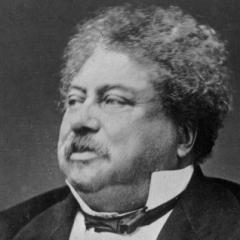
Alexandre Dumas
Alexandre Dumas

Alexandre Dumas, a renowned French writer, was born on July 24, 1802, and died on December 5, 1870. He is famous for his historical and adventure novels, with notable works including 'The Three Musketeers' and 'The Count of Monte Cristo'. more

You May Also Like

“In Japan, a number of time-honored everyday activities (such as making tea, arranging flowers, and writing) have traditionally been deeply examined by their proponents. Students study how to make tea, perform martial arts, or write with a brush in the most skillful way possible to express themselves with maximum efficiency and minimum strain. Through this efficient, adroit, and creative performance, they arrive at art. But if they continue to delve even more deeply into their art, they discover principles that are truly universal, principles relating to life itself. Then, the art of brush writing becomes shodo—the “Way of the brush”—while the art of arranging flowers is elevated to the status of kado—the “Way of flowers.” Through these Ways or Do forms, the Japanese have sought to realize the Way of living itself. They have approached the universal through the particular.”

“Photography is like stealing.You rob someone of a moment that exposes something essential about their character,their soul if you like.there are people who are very conscious of that,who find that terrifying.The thought that everyone,friend of foe,can get so close to you,look you straight in the eye and judge you without having any control over it or being able to respond.A part of them has become the property of the photographer.”

“Or consider a story in the Jewish Talmud left out of the Book of Genesis. (It is in doubtful accord with the account of the apple, the Tree of Knowledge, the Fall, and the expulsion from Eden.) In The Garden, God tells Eve and Adam that He has intentionally left the Universe unfinished. It is the responsibility of humans, over countless generations, to participate with God in a "glorious" experiment - the "completing of the Creation." The burden of such a responsibility is heavy, especially on so weak and imperfect a species as ours, one with so unhappy a history. Nothing remotely like "completion" can be attempted without vastly more knowledge than we have today. But, perhaps, if our very existence is at stake, we will find ourselves able to rise to this supreme challenge.”

“The thing is, and here we come to E. Gorey's Great Simple Theory About Art (which he has never tried to communicate to anybody else until now, so prepare for Severe Bafflement), that on the surface they are so obviously those situations that it is very difficult to see that they really are about something else entirely. This is the theory, incidentally, that anything is art, and it's the way I tell, is presumably about some certain thing, but is really always about something else, and it's no good having one without the other, because if you have the something it is boring and if you just have the something else it's irritating.”

“Gormenghast. Withdrawn and ruinous it broods in umbra: the immemorial masonry: the towers, the tracts. Is all corroding? No. Through an avenue of spires a zephyr floats; a bird whistles; a freshet beats away from a choked river. Deep in a fist of stone a doll's hand wriggles, warm rebellious on the frozen palm. A shadow shifts its length. A spider stirs... And darkness winds between the characters. - Gormenghast”