Quotessence
Home / Quotes / Quote by Vasily Grossman

Quote by Vasily Grossman

“While they were still transporting the grain, there was dust wherever you went. It was like clouds of smoke—over the village, over the fields, over the face of the moon at night. I remember one man going out of his mind. 'We're on fire!' he kept screaming. 'The sky is burning! The earth is burning!' No, it was not the sky—it was life itself that was burning.”

Quote by Vasily Grossman

Work

Forever Flowing

Browse quotes and source details for this work. more

Author

Vasily Grossman
Vasily Grossman

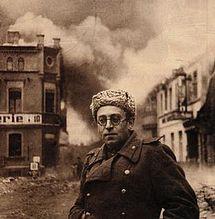
Vasily Grossman (December 12, 1905 – September 14, 1964) was a Soviet Jewish writer and journalist, best known for his works on World War II. Born in Berdychiv, Ukraine, he initially studied chemical engineering before turning to literature. As a war correspondent for the Red Star newspaper, he witnessed the Battle of Stalingrad and documented Nazi atrocities. His masterpiece, Life and Fate, was banned by Soviet authorities for its criticism of Stalinism and only published in the 1980s. Grossman's works explore themes of war, totalitarianism, and humanity, earning him recognition as a significant voice in 20th-century Russian literature. more

You May Also Like

“The doctor delivered a devastating diagnosis: a severe stroke with paralysis of the right side of her body, brought on by prolonged starvation. In the days that followed, Irina’s condition steadily deteriorated. The family took turns caring for her, carefully following every medical instruction, yet the decline was obvious. Within days, her left leg failed as well. She could no longer speak—only stare ahead in silent resignation. Whenever one of her loved ones approached her bedside, tears streamed soundlessly down her face. Now, sitting beside his grandmother’s pillow, Peter watched the boundless sorrow in her eyes as she looked at him. “Grandma, everything will be all right. You’ll recover,” the boy lied with all the gentleness he was capable of. “I love you.” He pressed his face to her chest and kissed her. Heavy tears rolled down Irina’s cheeks. A lump rose in Peter’s throat. He could not drive away the terrible thought: How could it be that only yesterday someone so alive, loving, and active—though ill—could so suddenly become a helpless ruin? It felt unnatural. It felt unjust. With each passing day, life faded from Irina. A week after the stroke, she died quietly in her sleep. At his grandmother’s funeral, Peter wept as he never had before—and never would again. He did not hide his tears. He kept kissing her cold lips, cheeks, and forehead. But each kiss only made the grief heavier. — Volodymyr Shablia, Stone. Book Three Context note: Set during the Holodomor of 1933 in Ukraine, this scene portrays one of the famine’s most tragic realities: the rapid decline and death of the elderly and the sick often among the first victims of starvation. Malnutrition weakened the body’s ability to survive illness, and strokes, infections, and organ failure became fatal in a society stripped of food and medical resources. Behind the statistics of millions dead were intimate family tragedies like this one.”

“I am for I think not (Sonnet 2674) Every country needs just one person to embody the best of humanity - but I couldn't wait to find those people, so I chose to be that person from every culture and every country, that's why I made these languages, these cultures, these soils, my own, no native, no foreign, it's all my own - I let their air fill my lungs, their passions permeate my veins, their tears galvanize my heart, their dreams resurrect my brain - which is why, some ask for water, some ask pani - somewhere I'm scientist, somewhere I'm sufi. I cannot explain this to your puny eurocentric analytical psyche, even to try would be like explaining neuroscience to a neanderthal - all I can say is, I am for I am not - I am for I think not - I don't live, I combust.”

“The Egyptians had what might to us seem a strange attitude to their gods. While they were happy to sing praises to their deities in order to coerce them into manifestation, they were not able threatening them either. Many spells have survived that promise all manner of dire consequences if the deity concerned does not fulfil the practioner’s wishes. These threats included the destruction of temples, the slaughter of sacred beasts, and perhaps worst of all, the deliberate refusal to acknowledge a god’s existence.”