Quotessence
Home / Quotes / Quote by Franz Kafka

Quote by Franz Kafka

“The most beautiful of your letters (and that means a lot, for as a whole they are, almost in every line, the most beautiful thing that ever happened to me in my life) are those in which you agree with my 'fear' and at the same time try to explain that I don't need to have it. For I too, even though I may sometimes look like a bribed defender of my 'fear', probably agree with it deep down in myself, indeed it is part of me and perhaps the best part. And as it is my best, it is also perhaps this alone that you love. For what else worthy of love could be found in me? But this is worthy of love.”

Quote by Franz Kafka

Work

Letters to Milena

This book is a compilation of letters that reveal a deep and personal relationship between two individuals amidst the backdrop of significant historical events. The correspondence offers a glimpse into the complexities of human emotions and the passage of time. more

Author

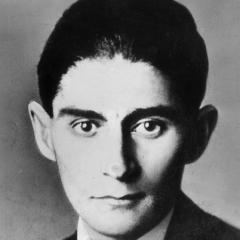
Franz Kafka
Franz Kafka

Franz Kafka (July 3, 1883 - June 3, 1924) was an important German-language novelist of the 20th century, known for his unique literary style and profound philosophical thoughts. His works, often themed around loneliness, alienation, and existentialism, have had a profound impact on literature and philosophy. more

You May Also Like

“I don't want to get landed in an affair which might get beyond my control before I knew where I was. [...] But darling, Virginia is not the sort of person one thinks of in that way. There is something incongruous and almost indecent in the idea. I have gone to bed with her (twice), but that's all. Now you know all about it, and I hope I haven't shocked you [...]”

“So far as the beggar woman is concerned, there was certainly neither anything good nor anything bad in it, I was simply too distracted or too much preoccupied with one thing to act in any other way but according to vague memories. And one such memory says, for instance: 'Don't give too much to beggars, you'll regret it later.' Once as a very small boy I was given a Sechserl and felt a great urge to hand it to an old beggar woman who sat between the Grosse and the Kleine Ring. But the sum seemed to me enormous, a sum which probably never before had been given to a beggar, so I was ashamed in front of the beggar woman to do something so unheard-of, but give it to her I felt I must. I therefore changed the Sechserl into ten Kreuzers, gave one to the beggar woman, ran round the whole block of the Town Hall and the arcade near the Kleine Ring, arrived from the left as a completely new benefactor, gave the beggar woman another Kreuzer, started to run again and actually made this round ten times (or maybe not quite so many, for I believe the beggar woman lost her patience later and disappeared). In any case, toward the end I was so exhausted, morally as well, that I ran straight home and cried until my mother replaced the Sechserl. You see, I have bad luck with beggars, but I declare myself prepared to pay out my entire present and future fortune in the smallest Viennese bank notes to a beggar woman standing by the Opera, on condition that you're present and I may feel you close to me.”