Quotessence
Home / Quotes / Quote by Ludwig Feuerbach

Quote by Ludwig Feuerbach

“[M]an … makes Nature merely the servant of his will and needs, and … degrades it to a mere machine, a product of the will. … [I]ts existence is intelligible to him, … he explains and interprets it out of himself, in accordance with his own feelings and notions.”

Quote by Ludwig Feuerbach

Work

Essence of Christianity

Browse quotes and source details for this work. more

Author
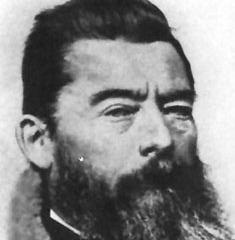
Ludwig Feuerbach
Ludwig Feuerbach

Ludwig Feuerbach, a prominent German philosopher born on July 28, 1804, and died on September 13, 1872. He was a significant figure in the German classical philosophy and had a profound impact on the birth of Marxist philosophy. more

You May Also Like

“To him who feels that Nature is lovely, it appears an end in itself, it has the ground of its existence in itself: … the question, Why does it exist? does not arise. … Nature, as it impresses his senses, has indeed had an origin, has been produced, but not created in the religious sense, … [H]e posits … as the ground of Nature, a force of Nature, - a real, present, visibly active force, as the ground of reality. … Anaxagoras (510-428BC : 'Life is a journey.'): - Man is born to behold the world. … [M]an contents himself, allows himself free play, … [with] the sensuous imagination alone. … [H]e lets Nature subsist in peace, and constructs his castles in the air. … When, on the contrary, man … is in disunion with Nature[,] he makes Nature the abject vassal of his selfish interest, of his practical egoism. … Nature or the world is made, created, the product of a command.”

“The complexity of the simplest known type of cell is so great that it is impossible to accept that such an object could have been thrown together suddenly by some kind of freakish, vastly improbable, event. Such an occurrence would be indistinguishable from a miracle.”

“[T]he contradiction in Catholicism, that at the same time marriage is holy and celibacy is holy. This simply realises as a practical contradiction, the dogmatic contradiction of the Virgin Mother. … [T]his wondrous union of virginity and maternity, contradicting Nature and reason, but in the highest degree accordant with the feelings and imagination, … The supranatural conception of Christ is a fundamental doctrine of Christianity, … As death [was] repugnant to the Christians, and … set aside by them through the supposed agency of miraculous power; so, necessarily, they had an equal repugnance to the natural processes of generation, and superseded it by miracle. The Miraculous Conception is not less welcome than the Resurrection to all believers; for it was the first step towards the purification of mankind, polluted by sin and Nature.”

“God as an object of thought … is always a remote being; the relation … is an abstract one, … So long as we have not met a being face to face, we are always in doubt whether he is really such as we imagine him; … Christ … is the … certainty that God is what the soul desires and needs him to be. … [O]nly in Christ is the last wish of religion realised, … [W]hat god is in essence, … Christ is in actual appearance.”