Quotessence
Home / Quotes / Quote by Franz Kafka

Quote by Franz Kafka

Work

The Trial

In this classic work, the protagonist, Joseph K., is arrested and subjected to a relentless and illogical trial. The narrative delves into the complexities of the legal system and the human condition, leaving readers pondering the nature of justice and the absurdity of life. more

Author

Franz Kafka
Franz Kafka

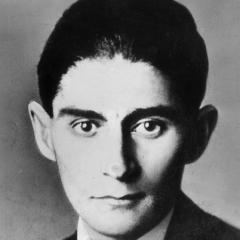
Franz Kafka (July 3, 1883 - June 3, 1924) was an important German-language novelist of the 20th century, known for his unique literary style and profound philosophical thoughts. His works, often themed around loneliness, alienation, and existentialism, have had a profound impact on literature and philosophy. more

You May Also Like

“Logic, reason, and common sense are your best tools for synthesizing reality and understanding what to do about it. Be wary of relying on anything else. Unfortunately, numerous tests by psychologists show that the majority of people follow the lower-level path most of the time, which leads to inferior decisions without their realizing it. As Carl Jung put it, “Until you make the unconscious conscious, it will direct your life and you will call it fate.” It’s even more important that decision making be evidence-based and logical when groups of people are working together. If it’s not, the process will inevitably be dominated by the most powerful rather than the most insightful participants, which is not only unfair but suboptimal. Successful organizations have cultures in which evidence-based decision making is the norm rather than the exception.”

“A proof represents a logical process which has come to a definitive conclusion in a finite number of stages. However, a logical machine following definite rules need never come to a conclusion. It may go on grinding through different stages without ever coming to a stop, either by describing a pattern of activity of continually increasing complexity, or by going into a repetitive process like the end of a chess game in which there is a continuing cycle of perpetual check. This occurs in the case of some of the paradoxes of Cantor and Russell. Let us consider the class of all classes which are not members of themselves. Is this class a member of itself? If it is, it is certainly not a member of itself; and if it is not, it is equally certainly a member of itself. A machine to answer this question would give the successive temporary answers: “yes,” “no,” “yes,” “no,” and so on, and would never come to equilibrium. Bertrand Russell’s solution of his own paradoxes was to affix to every statement a quantity, the so-called type, which serves to distinguish between what seems to be formally the same statement, according to the character of the objects with which it concerns itself—whether these are “things,” in the simplest sense, classes of “things,” classes of classes of “things,” etc. The method by which we resolve the paradoxes is also to attach a parameter to each statement, this parameter being the time at which it is asserted. In both cases, we introduce what we may call a parameter of uniformization, to resolve an ambiguity which is simply due to its neglect.”