“The first chapter of Matthew begins with giving a genealogy of Jesus Christ; and in the third chapter of Luke there is also given a genealogy of Jesus Christ. Did these two agree, it would not prove the genealogy to be true, because it might nevertheless be a fabrication; but as they contradict each other in every particular, it proves falsehood absolutely. If Matthew speaks truth, Luke speaks falsehood; and if Luke speaks truth, Matthew speaks falsehood: and as there is no authority for believing one more than the other, there is no authority for believing either; and if they cannot be believed even in the very first thing they say, and set out to prove, they are not entitled to be believed in any thing they say afterwards. Truth is an uniform thing; and as to inspiration and revelation, were we to admit it, it is impossible to suppose it can be contradictory. Either then the men called apostles were imposters, or the books ascribed to them have been written by other persons, and fathered upon them, as is the case in the Old Testament. Now, if these men, Matthew and Luke, set out with a falsehood between them (as these two accounts show they do) in the very commencement of their history of Jesus Christ, and of who, and of what he was, what authority (as I have before asked) is there left for believing the strange things they tell us afterwards? If they cannot be believed in their account of his natural genealogy, how are we to believe them when they tell us he was the son of God, begotten by a ghost; and that an angel announced this in secret to his mother? If they lied in one genealogy, why are we to believe them in the other? If his natural genealogy be manufactured, which it certainly is, why are we not to suppose that his celestial genealogy is manufactured also, and that the whole is fabulous? Can any man of serious reflection hazard his future happiness upon the belief of a story naturally impossible, repugnant to every idea of decency, and related by persons already detected of falsehood?”
Quote by Thomas Paine
Work
Pensado by Thomas Paine, this seminal text delves into the author's beliefs regarding the role of reason in understanding the world and its implications for religion and governance. It is a critical examination of the supernatural and the divine, advocating for a rational approach to understanding the universe. more
Author
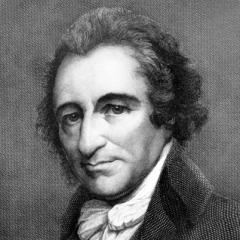
Thomas Paine, born on February 9, 1737, and died on June 8, 1809, was a prominent American writer, political figure, and philosopher during the American Revolutionary War. He is renowned for his radical democratic ideas and his contributions to the American independence movement. more
You May Also Like
“Stupid crowds are the greatest wealth of the crook politicians!”
“I put myself in places where I feel like I don't "belong" to get used to its for when I am there.”
“I will always seek to make it summer for you.”