Quotessence
Home / Quotes / Quote by Andrew Murray

Quote by Andrew Murray

“Of God are ye in Christ. It is not as if God placed and planted us in Christ, and left it to us now to maintain the union. No, God is the Eternal One, the God of the everlasting life, who works every moment in a power that does not for one moment cease. What God gives, He continues with a never-ceasing giving. It is He who by the Holy Spirit makes this life in Christ a blessed reality in our consciousness.”

Quote by Andrew Murray

Work

Holy in Christ: A devotional look at your life

Browse quotes and source details for this work. more

Author
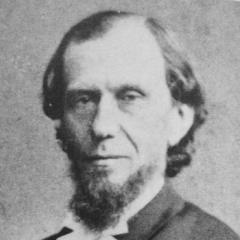
Andrew Murray
Andrew Murray

Andrew Murray was a 19th-century Scottish writer, missionary, and socialist. His works covered a wide range of fields, including religion, morality, society, and politics, and had a profound impact on posterity. more

You May Also Like

“Anxiety always originates from a lie. All lies, whether self generated or accepted from another person, will resonate as a pendulum swinging to and fro as a reminder of an inconsistency with truth and impeccability. The further the lie is carried, the more the intensity of anxiety builds. The feeling may begin as unease, building to angst, translating to anxiety, panic, and even dread. Ultimately, anxiety creates stagnancy. What's the solution? Speak the truth even if it scares you. Be authentic.”

“...Whilst on board the Beagle I was quite orthodox, and I remember being heartily laughed at by several of the officers... for quoting the Bible as an unanswerable authority on some point of morality... But I had gradually come by this time, i.e., 1836 to 1839, to see that the Old Testament from its manifestly false history of the world, with the Tower of Babel, the rainbow at sign, &c., &c., and from its attributing to God the feelings of a revengeful tyrant, was no more to be trusted than the sacred books of the Hindoos, or the beliefs of any barbarian. ...By further reflecting that the clearest evidence would be requisite to make any sane man believe in the miracles by which Christianity is supported, (and that the more we know of the fixed laws of nature the more incredible do miracles become), that the men at that time were ignorant and credulous to a degree almost uncomprehensible by us, that the Gospels cannot be proved to have been written simultaneously with the events, that they differ in many important details, far too important, as it seemed to me, to be admitted as the usual inaccuracies of eyewitnesses; by such reflections as these, which I give not as having the least novelty or value, but as they influenced me, I gradually came to disbelieve in Christianity as a divine revelation. The fact that many false religions have spread over large portions of the earth like wild-fire had some weight with me. Beautiful as is the morality of the New Testament, it can be hardly denied that its perfection depends in part on the interpretation which we now put on metaphors and allegories. But I was very unwilling to give up my belief... Thus disbelief crept over me at a very slow rate, but was at last complete. The rate was so slow that I felt no distress, and have never since doubted even for a single second that my conclusion was correct. I can indeed hardly see how anyone ought to wish Christianity to be true; for if so the plain language of the text seems to show that the men who do not believe, and this would include my Father, Brother and almost all of my friends, will be everlastingly punished. And this is a damnable doctrine.”