Quotessence
Home / Quotes / Quote by Ernest Hemingway

Quote by Ernest Hemingway

Author

Ernest Hemingway
Ernest Hemingway

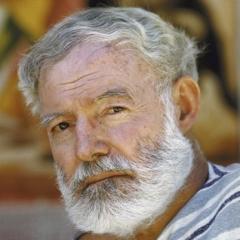
American author known for his concise and forceful writing style, as well as his profound insights into life. Hemingway's works cover a wide range of themes including war, adventure, and love, with notable titles such as 'The Old Man and the Sea' and 'A Farewell to Arms'. more

You May Also Like

“He began as a minor imitator of Fitzgerald, wrote a novel in the late twenties which won a prize, became dissatisfied with his work, stopped writing for a period of years. When he came back it was to BLACK MASK and the other detective magazines with a curious and terrible fiction which had never been seen before in the genre markets; Hart Crane and certainly Hemingway were writing of people on the edge of their emotions and their possibility but the genre mystery markets were filled with characters whose pain was circumstantial, whose resolution was through action; Woolrich's gallery was of those so damaged that their lives could only be seen as vast anticlimax to central and terrible events which had occurred long before the incidents of the story. Hammett and his great disciple, Chandler, had verged toward this more than a little, there is no minimizing the depth of their contribution to the mystery and to literature but Hammett and Chandler were still working within the devices of their category: detectives confronted problems and solved (or more commonly failed to solve) them, evil was generalized but had at least specific manifestations: Woolrich went far out on the edge. His characters killed, were killed, witnessed murder, attempted to solve it but the events were peripheral to the central circumstances. What I am trying to say, perhaps, is that Hammett and Chandler wrote of death but the novels and short stories of Woolrich *were* death. In all of its delicacy and grace, its fragile beauty as well as its finality. Most of his plots made no objective sense. Woolrich was writing at the cutting edge of his time. Twenty years later his vision would attract a Truffaut whose own influences had been the philosophy of Sartre, the French nouvelle vague, the central conception that nothing really mattered. At all. But the suffering. Ah, that mattered; that mattered quite a bit.”

“We teach girls to shrink themselves, to make themselves smaller. We say to girls, you can have ambition, but not too much. You should aim to be successful, but not too successful. Otherwise, you would threaten the man. Because I am female, I am expected to aspire to marriage. I am expected to make my life choices always keeping in mind that marriage is the most important. Now marriage can be a source of joy and love and mutual support but why do we teach girls to aspire to marriage and we don’t teach boys the same? We raise girls to see each other as competitors not for jobs or accomplishments, which I think can be a good thing, but for the attention of men. We teach girls that they cannot be sexual beings in the way that boys are.”

“I will never accept life for what it is. I don't need an easy life. My road was meant to be hard because anything worth having in this world will take me to the very edge of myself. I will overcome everything I have ever gone through and will make my future the one God intended me to have. I will pick up the pieces of this pain and sculpt it into art. I am not ordinary and never was. I walk into my birthright as a queen with her head held high. I was born to do this!”