“The communism of the ruling caste of his best city can thus be derived from Plato’s fundamental sociological law of change; it is a necessary condition of the political stability which is its fundamental characteristic. But although an important condition, it is not a sufficient one. In order that the ruling class may feel really united, that it should feel like one tribe, i.e. like one big family, pressure from without the class is as necessary as are the ties between the members of the class. This pressure can be secured by emphasizing and widening the gulf between the rulers and the ruled. The stronger the feeling that the ruled are a different and an altogether inferior race, the stronger will be the sense of unity among the rulers. We arrive in this way at the fundamental principle, announced only after some hesitation, that there must be no mingling between the classes.”
Quote by Karl Popper
Work
The Open Society and Its Enemies - Volume One: The Spell of Plato
Browse quotes and source details for this work. more
Author
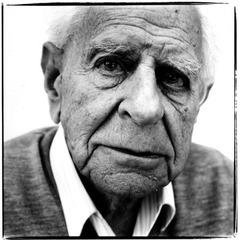
Karl Popper
Karl Popper (July 28, 1902 – September 17, 1994) was an influential philosopher known for his work on critical rationalism and falsificationism. He is renowned for his contributions to the philosophy of science, political philosophy, and epistemology, with his ideas having a profound impact on these fields. more
You May Also Like
Source: Joothan: An Untouchable's Life
Source: जूठन: पहला खंड [Joothan]
Source: Joothan: An Untouchable's Life
Source: जूठन: पहला खंड [Joothan]
Source: Down Along with That Devil's Bones: A Reckoning with Monuments, Memory, and the Legacy of White Supremacy
Source: Brave New World
“Never give advice unless you have walked the walk, because anybody can talk the talk.”
Source: Why Nepal Fails