Quotessence
Home / Quotes / Quote by Franz Kafka

Quote by Franz Kafka

“However, Gregor had become much calmer. All right, people did not understand his words any more, although they seemed clear enough to him, clearer than previously, perhaps because had gotten used to them”

Quote by Franz Kafka

Work

The Metamorphosis

Franz Kafka's 'The Metamorphosis' is a novella that delves into the psychological and social impact of sudden and extreme transformation. The narrative follows Gregor Samsa, a traveling salesman, who wakes up one morning to find himself transformed into a monstrous insect. The story examines the struggle for identity and the alienation experienced by Gregor in a world that cannot comprehend his metamorphosis. Kafka's work is renowned for its complex and haunting portrayal of the human condition, often reflecting the anxieties and existential concerns of modern life. more
Author

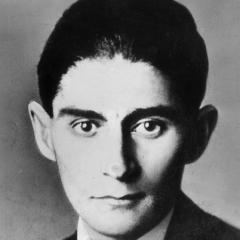
Franz Kafka
Franz Kafka

Franz Kafka (July 3, 1883 - June 3, 1924) was an important German-language novelist of the 20th century, known for his unique literary style and profound philosophical thoughts. His works, often themed around loneliness, alienation, and existentialism, have had a profound impact on literature and philosophy. more

You May Also Like

“In our day and age, global society has been saturated with the wrong teaching of false positivity. The denial of darkness never equates the abundance of light. And the denial of your actual character never equates to the reality of your best character. People today are afraid to work on themselves and on their actual realities, they believe that outward appearances are enough. Outward appearances have become everything in our current day and age. People don't see what they are actually like, nor who they actually are, in reality. They live in a phantasmic version of reality. It has to stop. In the phantasmic version of reality, there is no chance to experience true love, true goodness, and true metamorphosis. The caterpillar does not become a butterfly by telling everybody it has wings. It actually buries itself in darkness and grows those wings.”

“It's all very well to run around saying regulation is bad, get the government off our backs, etc. Of course our lives are regulated. When you come to a stop sign, you stop; if you want to go fishing, you get a license; if you want to shoot ducks, you can shoot only three ducks. The alternative is dead bodies at the intersection, no fish, and no ducks. OK? (Getting Control of the Frontier, Gainsville Sun, March 22, 1995)”

“I don't know that we are actually human at this point, those of us who are like most of us, who grew up with TV and movies and now the Internet. If we are betrayed, we know the words to say; when a loved one dies, we know the words to say. If we want to play the stud or the smart-ass or the fool, we know the words to say. We are all working from the same dog-eared script. It's a very difficult era in which to be a person, just a real, actual person, instead of a collection of personality traits selected from an endless Automat of characters. And if all of us are play-acting, there can be no such thing as a soul mate, because we don't have genuine souls. It had gotten to the point where it seemed like nothing matters, because I'm not a real person and neither is anyone else. I would have done anything to feel real again.”

“I'm an 'intelligent' sociopath. I don't have problems with drugs, I don't commit crimes, I don't take pleasure in hurting people, and I don't typically have relationship problems. I do have a complete lack of empathy. But I consider that an advantage, most of the time. Do I know the difference between right and wrong, and do I want to be good? Sure. ... A peaceful and orderly world is a more comfortable world for me to live in. So do I avoid breaking the law because it's 'right'? No, I avoid breaking the law because it makes sense.”

“Society has three stages: Savagery, Ascendance, Decadence. The great rise because of Savagery. They rule in Ascendance. They fall because of their own Decadence." He tells how the Persians were felled, how the Romans collapsed because their rulers forgot how their parents gained them an empire. He prattles about Muslim dynasties and European effeminacy and Chinese regionalism and American self-loathing and self-neutering. All the ancient names. "Our Savagery began when our capital, Luna, rebelled against the tyranny of Earth and freed herself from the shackles of Demokracy, from the Noble Lie - the idea that men are brothers and are created equal." Augustus weaves lies of his own with that golden tongue of his. He tells of the Goldens' suffering. The Masses sat on the wagon and expected the great to pull, he reminds. They sat whipping the great until we could no longer take it. I remember a different whipping. "Men are not created equal; we all know this. There are averages. There are outliers. There are the ugly. There are the beautiful. This would not be if we were all equal. A Red can no more command a starship than a Green can serve as a doctor!" There's more laughter across the square as he tells us to look at pathetic Athens, the birthplace of the cancer they call Demokracy. Look how it fell to Sparta. The Noble Lie made Athens weak. It made their citizens turn on their best general, Alcibiades, because of jealousy. "Even the nations of Earth grew jealous of one another. The United States of America exacted this idea of equality through force. And when the nations united, the Americans were surprised to find that they were disliked! The Masses are jealous! How wonderful a dream it would be if all men were created equal! But we are not. It is against the Noble Lie that we fight. But as I said before, as I say to you now, there is another evil against which we war. It is a more pernicious evil. It is a subversive, slow evil. It is not a wildfire. It is a cancer. And that cancer is Decadence. Our society has passed from Savagery to Ascendance. But like our spiritual ancestors, the Romans, we too can fall into Decadence.”

“When a husband loses his wife, they call him a widower. When a wife loses her husband, they call her a widow. And when somebody’s parents die, they call them an orphan. But there is no name for a parent, a grieving mother, or a devastated father who have lost their child. Because the pain behind the loss is so immeasurable and unbearable, that it cannot be described in a single word. It just cannot be described.”