Quotessence
Home / Quotes / Quote by Langston Hughes

Quote by Langston Hughes

“...Me, I do not want to go to no suburbans not even Brooklyn. But Joyce wants to integrate. She says America has got two cultures, which should not he divided as they now is, so let's leave Harlem." "Don't you agree that Joyce is right?" "White is right," said Simple, "so I have always heard. But I never did believe it. White folks do so much wrong! Not only do they mistreat me, but they mistreats themselves. Right now, all they got their minds on is shooting off rockets and sending up atom bombs and poisoning the air and fighting wars and Jim Crowing the universe." "Why do you say 'Jim Crowing the universe'?" "Because I have not heard tell of no Negro astronaughts nowhere in space yet. This is serious, because if one of them white Southerners gets to the moon first, COLORED NOT ADMITTED signs will go up all over heaven as sure as God made little green apples, and Dixiecrats will be asking the man in the moon, 'Do you want your daughter to marry a Nigra?' Meanwhile, the N.A.A.C.P. will have to go to the Supreme Court, as usual, to get an edict for Negroes to even set foot on the moon. By that time, Roy Wilkins will be too old to make the trip, and me, too." "But perhaps the Freedom Riders will go into orbit on their own," I said. "Or Harlem might vote Adam Powell into the Moon Congress.'' "One thing I know," said Simple, "is that Martin Luther King will pray himself up there. The moon must be a halfway stop on the way to Glory, and King will probably be arrested. I wonder if them Southerners will take police dogs to the moon?”

Quote by Langston Hughes

Work

The Return of Simple

Browse quotes and source details for this work. more

Author
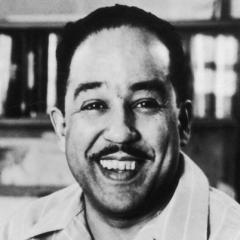
Langston Hughes
Langston Hughes

American poet, writer, playwright, editor, and actor. Langston Hughes is one of the most prominent figures of the Harlem Renaissance, known for his poetry and prose. His works often explore themes of race, class, and identity, and have been beloved by readers. more

You May Also Like

“We drove across the Red Square past Lenin's Mausoleum and the towers and domes of the Kremlin--and stopped a block away at the Grand Hotel. Our rooms were ready for us--clean and comfortable, with hot and cold water, homelike settees and deep roomy chairs. Courteous attendants were there, baths and elevator, a book shop and two restaurants. Everything that a hotel for white folks at home would have--except that, quite truthfully, there was no toilet paper. And no Jim Crow. Of course, we knew that one of the basic principles of the Soviet Union is the end of all racial distinctions. That's the main reason we had come to Moscow.”

“On one side of the tracks was the commercial center: the college, city hall, businesses, white residential neighborhoods-carefully kept that way, first by deliberate redlining and later by Jim Crow... Through the sixties, the city of Commerce was known as a "sundown town"- any Black person found of the streets after dark was in danger of being lynched. The only place where Black citizens were safe from the threat of white violence was also the only place Black people were legally allowed to reside: Norris Community, known fondly by younger generations as "the Hole".”

“I'm just as aware of the injustices done to the black man as anyone," the Dipper would explain years after. "I just don't believe that you help things by running around, saying how evil Whitey is. I figure I done my share - the restaurants I integrated in Kansas, the busloads of black kids I used to take to summer camp from Harlem, the contributions I make, in my name and money, to various black causes and programs. Just because I don't call a press conference every time I do something like that doesn't mean I am insensitive to the black man's plight.”

“What you are about to read is the story of the first war on terror. No ... wait. This is actually the origin story of second-wave white supremacy known as "Jim Crow laws." This is a war narrative. This is a horror story, but it's also a suspense thriller that ends in triumph. It also ends in tragedy. It's a true story about a fantastic myth. This is a narrative, nonfiction account of the all-American fairy tale of liberty and justice for all. Behold, the untold story of the Great American Race War. Before we begin, we shall introduce our hero. The hero of this drama is Black people. All Black people. The free Blacks; the uncloaked maroons; the Black elite; the preachers and reverends; the doormen and doctors; the sharecroppers and soldiers—they are all protagonists in our epic adventure. Spoiler alert: the hero of this story does not die. Ever. This hero is long-suffering but unkillable. Bloody and unbowed. In this story—and in all the subsequent sequels, now and forever—this hero almost never wins. But we still get to be the heroes of all true American stories simply because we are indestructible. Try as they might, we will never be extinguished. Ever.”

“And what was the cost of this Jim Crow? Not merely that the precious words "America" and "freedom" became suspect in the eyes of the world, but more than that. It cost us lives. Lives of white men, of Frenchmen, Russians and Chinese-because there were many battles in this war when replacements were needed. But the American rule of war was "No Negroes allowed on the front lines" until the 92d finally got there. I listened to the Axis radio. Tokyo Rose said, and she quoted American sources, that Negroes were good enough to serve in the American Army, but they weren't good enough to pitch in the American Big League baseball. And they broadcast this not only to our own troops but also to the billion and a half colored peoples of the earth.”