Quotessence
Home / Quotes / Quote by Victor Hugo

Quote by Victor Hugo

Work

Les Misérables

Victor Hugo's 'Les Misérables' is an epic narrative that delves into the lives of various characters, including Jean Valjean, a former convict seeking redemption, and Fantine, a woman struggling in poverty. The story is rich in historical detail and moral complexity, offering a profound examination of society's flaws and the resilience of the human spirit. more
Author

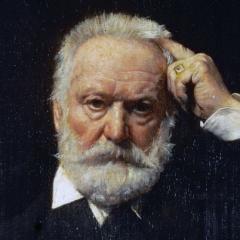
Victor Hugo
Victor Hugo

Victor Hugo, a French romantic poet, novelist, and playwright, was born on February 26, 1802, and died on May 22, 1885. He is considered one of the greatest writers in French literary history, known for his profound humanistic concerns and rich imagination. more

You May Also Like

“Katkada je sudbina kao mala pješčana oluja koja stalno mijenja smjer. Ti promijeniš smjer, ali pješčana te oluja progoni. Opet skreneš, ali oluja se prilagodi. Neprekidno se tako igraš, kao u nekakvu zlosutnom plesu sa smrti točno prije zore. Zašto? Zato što ta oluja nije nešto što je zapuhalo iz daljine, nešto što nema nikakve veze s tobom. Ta oluja si ti. Nešto unutar tebe. Tako je sve što možeš učiniti to da joj se predaš, da stupiš upravo unutar te oluje, sklopivši oči i začepivši uši da u njih ne ulazi pijesak, i kroz nju ideš, korak po korak. Tu nema sunca, ni mjeseca, ni pravca, ni osjećaja vremena. Samo fini pijesak što se kovitla u nebo kao kosti samljevene u prah. To je vrsta pješčane oluje koju trebaš zamisliti. I doista ćeš se morati probijati kroz tu silovitu, metafizičku, simboličnu oluju. Bez obzira koliko metafizička ili simbolična bila, nemoj se zavaravati: ona će se zasijecati u meso kao tisuću oštrica britve. Ljudi će u njoj krvariti, i ti ćeš krvariti. Vrelom, crvenom krvlju. Hvatat ćeš tu krv u šake, vlastitu krv i tuđu krv. A kada jednom oluja prođe nećeš se sjećati kako si uspio preživjeti. Nećeš biti ni siguran, zapravo, je li oluja stvarno prošla. Ali jedna stvar je izvjesna. Kad izađeš iz oluje nećeš biti ista ona osoba koja je u nju ušla.”

“Molawa jumped back, frightened. He stared at the ground. “I don’t smell the blood though, bruh. Is my smeller broken?” He gingerly felt his nose. “It feels not broken to me. Check it?” Eleu stepped towards Molawa and grabbed at his nose. “Definitely broke. Get it fixed. Even though it’s broke, you smell the blood.” Molawa’s eyes widened, the power of suggestion was too much. “No, no, no, you’re right! I smell so much blood. What are we bruh, sharks?” Eleu shrugged. “I wouldn’t be surprised if we had some shark DNA in us. I don’t know the names of all of my ancestors. One coulda been a shark.” Molawa nodded furiously. “Truth. I don’t know all my ancestors either. And I like to eat fish. It makes too much sense. Bruh. Thank you.” Eleu nodded sincerely. Then turned his attention back to the door. “Hey, you giants. We know you’re in there. Come on out, you stupids. And don’t try anything. There are two sharks out here.”

“When the islands were taken over, the princess, Ka’iulani, who had been tricked out of her kingdom cried out to Aloha Ke Akua.” The dots danced into the figure of a young woman, broken-hearted, sobbing on the floor beside her bed. “Aloha Ke Akua’s heart was torn apart by what he saw, so in one last act he touched the island of O’ahu.” The dots formed a giant hand and finger that touched the shape of the island. “And created Hunaia Awāwa. A sanctuary. The resting place of the resting place.”

“Political convictions then were of the utmost importance, so intensely felt that it was difficult even for well-balanced and temperate men to think of the opposition party without bitterness. To the rank and file of the Federalists, the Democrats seemed a vulgar, ignorant mob at best, at worst a group of "knaves and blockheads." To the Democrats, the Federalists appeared abandoned traitors fawning at the feet of the British government, a blindly selfish aristocracy who deserved little better treatment than the French nobility had received a few years before during the Reign of Terror.”

“The Puritans are conventionally considered more "moderate" than the Pilgrims. This is like calling al-Qaeda more moderate than ISIS. The Massachusetts Bay Colony Puritans were no less mad... They forbade Church of England clergy from setting foot in their new American theocracy in Boston and Salem, hung Quakers, and passed a law to hang any Catholic priests who might dare show up.”

“The Cambridge flowers had a moral meaning...but they had a poetical meaning that was even more apparent. So did the sounds one heard on summer evenings, the bells of the cows ambling home at twilight, the lullaby of the crickets in early autumn, the hymns of the frogs, in spring, in some neighbouring swamp, not to speak of the creaking of the winter wood-sleds, dragging their loads of walnut over the complaining snow. Every sound and odour had its value.”

“It's no devil,' I said. 'And why do you say that?' she asked again, as if we hadn't discussed this before. 'Because,' I said, 'the Devil has more important things to do if he exists at all, and on the point of his existence at all I am not certain.' 'Where did you get an idea there was no Devil?' 'Rousseau,' I said. 'His philosophy argues that the worst evil is in man.”