Quotessence
Home / Quotes / Quote by Martin Luther

Quote by Martin Luther

“God once spoke through the mouth of an ass. I will tell you straight what I think. I am a Christian theologian and I am bound not only to assert, but to defend the truth with my blood and death. I want to believe freely and be a slave to the authority of no one, of a council, a university, or pope. I will confidently confess what appears to me to be true whether it has been asserted by a Catholic or a heretic, whether it has been approved or reproved by a council.”

Quote by Martin Luther

Author
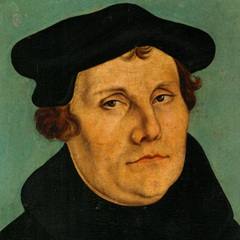
Martin Luther
Martin Luther

Martin Luther, born on November 10, 1483 and died on February 18, 1546, was a significant figure in the German Reformation. He was a monk, theologian, philosopher, and writer, known for his leading role in the Reformation. Luther challenged the authority of the Roman Catholic Church and translated the Bible into German, which had a profound impact on German culture and religion. more

You May Also Like

“Since in fact liturgical traditions, vestments, church vessels, etc., were immediately removed wherever Calvinism infiltrated or Reformed ideas even gained influence in the church's polity, the reaction which it caused in Lutheran areas was a conscious propensity for ceremonies. Henceforth, therefore, the celebration of an emphatically liturgical service was among the visible signs by which the Lutheran character of confession was demonstrated outwardly.”

“It is the distinctive position of the Reformation with which, over against Rome, it stands or falls, that that which properly constitutes, defines, and perpetuates in unity a Church, is its doctrine, not its name or organization. While a Church retains its proper identity it retains of necessity its proper doctrine. Deserting its doctrine it loses its identity. The Church is not a body which bears its name like England, or America, which remain equally England and America, whether savage or civilized, Pagan or Christian, Monarchical or Republican. Its name is one which properly indicates its faith--and the faith changing, the Church loses its identity. Pagans may become Mohammedans, but then they are no longer Pagans--they are Mohammedans. Jews may become Christians, but then they are no longer Jews in religion. A Manichean man, or Manichean Church, might become Catholic, but then they would be Manichean no more. A Romish Church is Romish; a Pelagian Church is Pelagian; a Socinian Church is Socinian, though they call themselves Protestant, Evangelical, or Trinitarian. If the whole nominally Lutheran Church on earth should repudiate the Lutheran doctrine, that doctrine would remain as really Lutheran as it ever was. A man, or body of men, may cease to be Lutherans, but a doctrine which is Lutheran once, is Lutheran forever. Hence, now, as from the first, that is not a Lutheran Church, in the proper and historical sense, which cannot ex animo declare that it shares in the accord and unanimity with which each of the Doctrines of the Augsburg Confession was set forth.”

“Galatians 3:11–12 ... a precious text! A person becomes righteous in the sight of God by faith alone. What conclusion can we draw from this? The law cannot make any person righteous because it has nothing to say about justifying and saving faith. That information is found only in the Gospel. In other words, the law has nothing to say about grace.”

“Lutheran ideology unleashed libido to achieve its political and ecclesial ends, and Luther, like Hugh Hefner, discovered that the only way to make use of libido effectively was to create for his contemporaries an escape from the guilt that accompanied its satisfaction. The sixteenth-century equivalent of the Playboy Philosophy was justification by faith alone, culminating in the doctrine of the enslaved will. De Servo Arbitrio, it should be remembered, was published in the same year that Luther married. Luther, in creating his doctrine of the enslaved will, became the first modern man, and Lutheranism became the first modern ideology. Its primary attraction to the hordes of apostate priests and nuns who flocked to Wittenberg to follow him lay in its ability to rationalize sexual license and broken vows.”

“Anders, it is not your sins that separate you from God, but your virtues. Or more properly: it is that you need to have something to bring before you step before God. This is why God has allowed you to be stripped of the shroud of holiness that you wore in Fröjerum. Not because you were zealous and pious. God grant that all priests would be as zealous as you! But because you made it into an article of faith and into your righteousness and put it between you and Christ. Now you are poor, destitute, and naked—like the prodigal son. Now the heavenly Father stand and waits for you. Now he wants to fold you in his arms and clothe you with the most precious garment, which is called Christ’s righteousness, in which not a single thread is spun by your hands, but for just that reason it lasts forever.”

“Heaven's eucharistic irruption into earthly space and time prompted classical Lutheranism not to join the Reformed and Anabaptists in their campaign of iconoclasm which rendered Christian churches little different in external appearance from Islamic mosques. While conceding the adiaphorous quality of images representing various aspects of the Incarnate Life, as early as his conflict with Karlstadt the Reformer defended the appropriateness of the crucifix and sculptures of Mary with the Christ Child. Orthodox Lutheran architecture and church decor attested the confession of our Lord's presence among His own in the means of grace, forging a style which goes hand in hand with precious doctrinal substance. Increasing accommodation to the North American Puritan milieu over the past century has led to a loss of the genuinely Lutheran understanding of the altar as a monument to the atonement, which is Christ's throne in our midst. ... If our chancels' decoration (or stark lack thereof) bespeaks the absence of our Lord and His celestial companions, can we be surprised at waning faith in the real presence and at waxing conviction of the rightfulness of an open communion practice? A deliberate opting for Puritanism's aesthetic barrenness can only make the reclaiming of Lutheran substance an even harder struggle.”