Quotessence
Home / Quotes / Quote by Saul Alinsky

Quote by Saul Alinsky

“A word about my personal philosophy. It is anchored in optimism. It must be, for optimism brings with it hope, a future with a purpose, and therefore, a will to fight for a better world. Without this optimism, there is no reason to carry on. If we think of the struggle as aclimb up a mountain, then we must visualize a mountain with no top. We see a top, but when we finall yreach it, the overcast rises and we find ourselves merely on a bluff. The mountain continues on up. Now we see the "real" top ahead of us, and strive for it, only to find we've reached another bluff, the top still above us. And so it goes on, interminably. Knowing that the mountain has no top, that it is a perpetual quest from plateau to plateau, the question arises, "Why the struggle, the conflict, the heartbreak, the danger, the sacrifice. Why the constant climb?" Our answer is the same as that which a real mountain climber gives when he is asked why he does what he does. "Because it's there." Because life is there ahead of you and either one tests oneself in its challenges or huddles in the valleys of a dreamless day-to-day existence whose only purpose is the preservation of a illusory security and safety. The latter is what the vast majority of people choose to do, fearing the adventure into the known. Paradocically, they give up the dream of what may lie ahead on the heighs of tomorrow for a perpetual nightmare - an endless succession of days fearing the loss of a tenuous security.”

Quote by Saul Alinsky

Work

Rules for Radicals: A Pragmatic Primer for Realistic Radicals

This book provides a comprehensive framework for political activism, detailing various strategies and tactics employed by radicals and activists. It explores the principles and methods used to influence social change and is considered a foundational text in the field of political organizing. more

Author
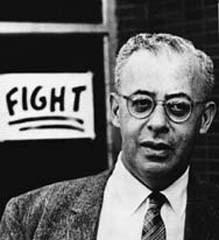
Saul Alinsky
Saul Alinsky

Saul Alinsky was an American writer and community organizer recognized for his seminal work in the realm of social activism. He is predominantly known for his seminal book 'Rules for Radicals', which has profoundly influenced contemporary political tactics and community organizing principles. more

You May Also Like

“If you really believed that you'd lost your soul, then when I found you in Volterra, you would have realized immediately what was happening, instead of thinking we were both dead together. But you didn't―you said 'Amazing. Carlisle was right,'" I reminded him, triumphant. "There's hope in you, after all." For once, Edward was speechless. "So let's both just be hopeful, all right?" I suggested. "Not that it matters. If you stay, I don't need heaven." He got up slowly, and came to put his hand on either side of my face as he stared into my eyes. "Forever," he vowed, still a little staggered. "That's all I'm asking for," I said, and stretched up on my toes so that I could press my lips to his.”

“This most beautiful system of the sun, planets and comets, could only proceed from the counsel and dominion of an intelligent and powerful Being... This Being governs all things, not as the soul of the world, but as Lord over all; and on account of his dominion he is wont, to be called Lord God παντοκρατωρ or Universal Ruler.”

“God is not needed to create guilt or to punish. Our fellow men suffice, aided by ourselves. You were speaking of the Last Judgement. Allow me to laugh respectfully. I shall wait for it resolutely, for I have known what is worse, the judgement of men. For them, no extenuating circumstances; even the good intention is ascribed to crime. Have you at least heard of the spitting cell, which a nation recently thought up to prove itself the greatest on earth? A walled-up box in which the prisoner can stand without moving. The solid door that locks him in the cement shell stops at chin level. Hence only his face is visible, and every passing jailer spits copiously on it. The prisoner, wedged into his cell, cannot wipe his face, though he is allowed, it is true. to close his eyes. Well, that, mon cher, is a human invention. They didn't need God for that little masterpiece.”

“My chances of returning to America were small, and I thought with regret about all the things I would miss about America: the TV dinner; air-conditioning; a well-regulated traffic system that people actually followed; a relatively low rate of death by gunfire, at least compared with our homeland; the modernist novel; freedom of speech, which, if not as absolute as Americans liked to believe, was still greater in degree than in our homeland; sexual liberation; and, perhaps most of all, that omnipresent American narcotic, optimism, the unending flow of which poured through the American mind continuously, whitewashing the graffiti of despair, rage, hatred, and nihilism scrawled there nightly by the black hoodlums of the unconscious. There were also many things about America with which I was less enchanted, but why be negative?”