Quotessence
Home / Quotes / Quote by Marcel Proust

Quote by Marcel Proust

“The sea refreshes our imagination because it does not make us think of human life; yet it rejoices the soul, because, like the soul, it is an infinite and impotent striving, a strength that is ceaselessly broken by falls, an eternal and exquisite lament. The sea thus enchants us like music, which, unlike language, never bears the traces of things, never tells us anything about human beings, but imitates the stirrings of the soul. Sweeping up with the waves of those movements, plunging back with them, the heart thus forgets its own failures and finds solace in an intimate harmony between its own sadness and the sea’s sadness, which merges the sea’s destiny with the destinies of all things.”

Quote by Marcel Proust

Work

The Complete Short Stories of Marcel Proust

This book gathers a selection of Marcel Proust's short stories, showcasing his distinctive literary style and exploration of complex themes. more

Author
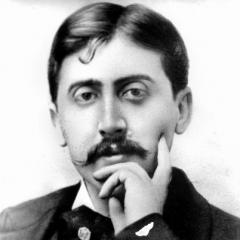
Marcel Proust
Marcel Proust

Marcel Proust was a French novelist renowned for his magnum opus, 'In Search of Lost Time'. This novel is considered a classic of 20th-century literature, known for its intricate psychological portrayals and profound exploration of memory. more

You May Also Like

“See that house with the Ivy on it? From that rooftop, what if you leapt onto the next rooftop, dashed over that blue & green wall, climbed and jumped up the pipe, ran across the roof and jumped to the next? You can, in animation. If you could walk along the cable, you could see the other side. When you look from above, so many things reveal themselves to you. Maybe race along the concrete wall. Suddenly, there in your humdrum town there is a magical movie. Isn’t it fun to see things that way? Feels like you could go somewhere far beyond… …maybe you can…”

“In every possibility of a mind May you travel, yet not blind. As a head filled with imagination, Goes a heart full of gold creation, It's never late to have a dream. Nor is it so far away as it seems, And, like a rearview mirror reveals, Thus a fantasy soon becomes real. It may be closer than it appears. Or at least it will show up clear. Never give up a dream for fear!”

“Imagination envisions what could be. Reality states what is. And when my journey is shaped by one of these at the exclusion of the other, I will eventually wake up on some road facing the ‘reality’ that I’m far more lost than I could have ‘imagined’.”

“A letter from a French cleric to Nicholas of St. Albans, written c. 1178, rehearsed what was already a familiar perception: Your island is surrounded by water, and not unnaturally its inhabitants are affected by the nature of the element in which they live. Unsubstantial fantasies slide easily into their minds. They think their dreams to be visions, and their visions to be divine. We cannot blame them, for such is the nature of their land. I have often noticed that the English are greater dreams than the French.”

“In real life I fell easily under the spell of all traveling artists. En route to New Orleans, entertainments of many kinds would stop over in those days for a single performance in Jackson's Century Theatre. Then, as now, my imagination was magnetized toward transient artists - toward the transience as much as the artists. I must have seen "Acrobats in a Park" at the time I wrote the story as exotic, free of any experience as I knew it. At the center of the little story is the Zorro's act: the feat of erecting a structure of their bodies that holds together, interlocked, and stands like a wall. Writing about the family act, I was writing about the family itself, its strength as a unit, testing its frailty under stress. I treated it in an artificial and oddly formal way; the stronghold of the family is put on view as a structure built each night; on the night before the story opens, the Wall has come down when the most vulnerable member slips, and the act is done for. But from various points within it and from outside it, I've been writing about the structure of the family in stories and novels ever since. In spite of my uncompromising approach to it, my fundamental story form might have been trying to announce itself to me.”