Quotessence
Home / Quotes / Quote by Herman Melville

Quote by Herman Melville

“Men may seem detestable as joint stock-companies and nations; knaves, fools, and murderers there may be; men may have mean and meagre faces; but man, in the ideal, is so noble and so sparkling, such a grand and glowing creature, that over any ignominious blemish in him all his fellows should run to throw their costliest robes. That immaculate manliness we feel within ourselves, so far within us, that it remains though all the outer character seem gone; bleeds with keenest anguish at the undraped spectacle of a valor-ruined man.”

Quote by Herman Melville

Work

Moby Dick

Moby Dick is a profound and complex novel that explores themes of obsession, fate, and the human condition. The story is narrated by Ishmael, a young man who signs on as a crew member of the Pequod, a whaling ship captained by the obsessed Ahab. The journey is fraught with danger and moral dilemmas, as the crew faces the perils of the sea and the relentless pursuit of their nemesis. The novel is renowned for its vivid descriptions of the ocean and its creatures, as well as its philosophical and existential musings. more

Author

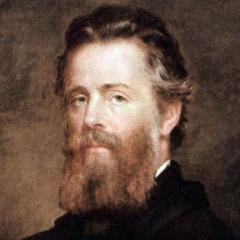
Herman Melville
Herman Melville

Herman Melville was a renowned 19th-century American novelist known for his profound psychological descriptions and unique literary style. His masterpiece, 'Moby-Dick', is considered a classic of American literature. more

You May Also Like

“Man," said the Ghost, "if man you be in heart, not adamant, forbear that wicked cant until you discovered What the surplus is, and Where it is. Will you decide what men shall live, what men shall die? It may be, that in the sight of Heaven, you are more worthless and less fit to live than millions like this poor man's child. Oh God! to hear the Insect on the leaf pronouncing on the too much life among his hungry brothers in the dust!”

“The question arises: What is God? God is man's consciousness, his awareness, his I AMness. The drama of life is a psychological one in which we bring circumstances to pass by our attitudes rather than by our acts. The corner-stone on which all things are based is mans concept of himself. He acts as he does, and has the experiences that he does, because his concept of himself is what it is, and for no other reason. Had he a different concept of himself, he would act differently and have different experiences.”

“It is my desperate wish to walk in something bigger than myself simply because to walk in myself is to live a life of small circles and ever-tightening walls. I am dying to walk in something bigger than all of mankind combined because in walking with mankind I am repeatedly faced with the very same circles and exact same walls. I wish neither of these. Rather, I want to walk in God because in Him there are no circles, walls are unknown, and horizons are the theme of everything He does.”

“I could see the road ahead of me. I was poor and I was going to stay poor. But I didn’t particularly want money. I didn’t know what I wanted. Yes, I did. I wanted someplace to hide out, someplace where one didn’t have to do anything. The thought of being something didn’t only appall me, it sickened me. The thought of being a lawyer or a councilman or an engineer, anything like that, seemed impossible to me. To get married, to have children, to get trapped in the family structure. To go someplace to work every day and to return. It was impossible. To do things, simple things, to be part of family picnics, Christmas, the 4th of July, Labor Day, Mother’s Day … was a man born just to endure those things and then die? I would rather be a dishwasher, return alone to a tiny room and drink myself to sleep.”