Quotessence
Home / Quotes / Quote by Elie Wiesel

Quote by Elie Wiesel

“Even if I wrote on nothing else, it would never be enough, even if all the survivors did nothing but write about their experiences, it would still not be enough. *Response when asked how much longer is he going to write about the Holocaust”

Quote by Elie Wiesel

Work

All Rivers Run to the Sea: Memoirs

This book is a compilation of the author's personal experiences and insights, offering a narrative of their life journey. more

Author
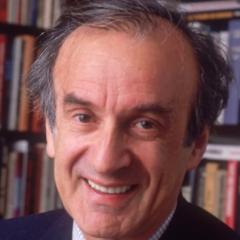
Elie Wiesel
Elie Wiesel

A renowned Jewish author and Nobel Peace Prize laureate, Elie Wiesel is known for his profound literary achievements and for recording and spreading the history of the Holocaust as a survivor. His works deeply reveal the terror of the Nazi Holocaust and the universal nature of human suffering. more

You May Also Like

“To deny the reported six million (approximately) Jews who died, or the 11 million people in total, is to ignore all the eyewitness accounts from Holocaust survivors, the non-Jewish witnesses of the millions who died the open-air massacres around Europe, the concentration camp guards, Nazi officers who admitted to gassings and other related crimes immediately after WW2, and the universal agreement of all mainstream historians who have studied this historical event inside out – not to mention every single scientist who has ever analyzed forensic evidence retrieved from the Nazi genocide. Not even the most corrupt courtroom on Earth could ignore this much evidence – for collectively these confirmations of the Holocaust equate to irrefutable proof that the reported death toll is indeed correct. It is possibly the most well-documented crime of the 20th Century, but remember for religious extremists, Nazi apologists or other anti-Semites it would never matter how much evidence you put in front of them. They would always deny the Holocaust because to admit the event occurred would be to stop believing the Jews are inferior to them. It would also require such bigots to admit the very uncomfortable truth to themselves: that their ‘own kind’ did these despicable things to the Jewish people.”

“As a matter of fact, the idea of death seeped into our blood. We would die, anyway, whatever happened. We would be gassed, we would be burned, we would be hanged, or we would be shot. The members of the underground at least knew that if they died, they would die fighting for something.”

“And so the picture that I showed her that Sunday, a picture I'd seen countless times since I was a boy, brought home to me for the first time the strangeness of my relationship to the people I was interviewing, people who were rich in memories but poor in keepsakes, whereas I was so rich in the keepsakes but had no memories to go with them.”

“Harry H. Laughlin was highly important for the Nazi crusade to breed a “master race.” This American positioned himself to have a significant effect on the world’s population. During his career Laughlin would: ~ Write the “Model Eugenical Law” that the Nazis used to draft portions of the Nuremberg decrees that led to The Holocaust. ~ Be appointed as “expert” witness for the U.S. Congress when the 1924 Immigration Restriction Act was passed. The 1924 Act would prevent many Jewish refugees from reaching the safety of U.S. shores during The Holocaust. ~ Provide the "scientific" basis for the 1927 Buck v. Bell Supreme Court case that made "eugenic sterilization" legal in the United States. This paved the way for 80,000 Americans to be sterilized against their will. ~ Defend Hitler's Nuremberg decrees as “scientifically” sound in order to dispel international criticism. ~ Create the political organization that ensured that the “science” of eugenics would survive the negative taint of The Holocaust. This organization would be instrumental in the Jim Crow era of legislative racism. H.H. Laughlin was given an honorary degree from Heidelberg University by Hitler's government, specifically for these accomplishments. Yet, no one has ever written a book on Laughlin. Despite the very large amount of books about The Holocaust, Laughlin is largely unknown outside of academic circles. The Carnegie Institution of Washington, D.C. gave this author permission to survey its internal correspondence leading up to The Holocaust and before the Institution retired Laughlin. These documents have not been seen for decades. They are the backbone of this book. The story line intensifies as the Carnegie leadership comes to the horrible realization that one of its most recognized scientists was supporting Hitler’s regime.”

“There is a gaping hole in the history of the Holocaust. Between Adolf Hitler and Joseph Mengele there was a hierarchy of scientists whom were responsible for writing the infamous racial legislation of the Third Reich. These scientists, doctors, and legislators enjoyed prestigious positions in the various institutions within Hitler's Germany. To be more precise, many of the ghastly experiments credited to Mengele were ordered by this group of high-ranking scientists and doctors. Mengele was following their orders, yet many of these German doctors and scientists were set free after being captured by the Allies. Previously unpublished manuscripts, correspondence, and conveniently forgotten publications reveal professional and political relationships as well as shared scientific convictions between high-profile American Progressives, British Fabian Socialists, and their German counterparts. The mounting evidence points to the long-standing designs and machinations of "scientific racism", a still poorly understood aspect of history. This book documents the hundred year trajectory of the history of "scientific racism" from its initial intentions to create "a race of masters" to the Holocaust, which resulted from Hitler's conviction to create a "master race". These scientific prejudices and political dogmas are as relevant today as they were leading up to WWII. A thorough understanding of the origins of this movement is in order.”