Quotessence
Home / Quotes / Quote by Ayn Rand

Quote by Ayn Rand

“But to think is an act of choice. The key to what you so recklessly call 'human nature,' the open secret you live with, yet dread to name, is the fact that man is a being of volitional consciousness. Reason does not work automatically; thinking is not a mechanical process; the connections of logic are not made by instinct. The function of your stomach, lungs or heart is automatic; the function of your mind is not. In any hour and issue of your life, you are free to think or evade that effort. But you are not free to escape from your nature, from the fact that reason is your means of survival - so that for you, who are a human being, the question 'to be or not to be' is the question 'to think or not to think”

Quote by Ayn Rand

Work

Atlas Shrugged

Atlas Shrugged is a novel that delves into themes of individualism, objectivism, and economic theory. It follows a diverse cast of characters as they navigate a dystopian future where the productive members of society withdraw their efforts in protest against the oppressive government. more

Author

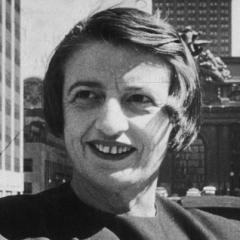
Ayn Rand
Ayn Rand

American novelist and philosopher, known for her novels and philosophical ideas. Her works emphasize individualism, free markets, and rationalism, and have had a profound impact on politics and philosophy in the late 20th century. more

You May Also Like

“Ever since the rise of fear in the hominid psyche, one way or another, the grounds for an ever-active anti-fear mechanism was being prepared in the soft soil of consciousness by the process of natural selection. It is a process that deems survival potential as the only measure for existence. And by this measure, the anti-fear, anti-anxiety, anti-depressant mechanism, which later humans named "God", proved to be extremely effective. It delivered solace to the scared psyche of the early humans in their times of utter distress. In the midst of darkness, this one imaginative idea gave them light and hope.”

“We must nurture the lotus of knowledge, not play in the pond with it, and rip it apart like children. We must mature and discuss correctly what we mean by faith, by its definition and by its scientific and poetic effect on the human heart and psychology and the total nature of our humanity.”

“Perhaps it is time to question goals that run counter to near-universal behavior. There may be lessons for us in the failure of Soviet-style Communism. It is our era's foremost example of a system that made mesmerizing promises of an earthly paradise but betrayed those promises. Millions of people were inspired by an ideology that would do away with capitalist exploitation. Marxists believed that the working class would seize the means of production, the state would wither away, selfishness would disappear, and man would live 'from each according to his ability to each according to his needs.' In the name of this ideology millions gave their lives and took the lives of millions of others. Communism failed. It failed for many reasons, not least because it was a misreading of human nature. Selfishness cannot be abolished. People do not work just as hard on collective farms as they do on their own land. The almost universal rejection of Communism today marks the acceptance of people as they are, not as Communism wished them to be. Is it possible that our racial ideals assume that people should become something they cannot? If most people prefer the company of people like themselves, what do we achieve by insisting that they deny that preference? If diversity is a weakness rather than a strength, why work to increase diversity?”

“The wedded couple lived in London. The man, under pretence of going a journey, took lodgings in the next street to his own house, and there, unheard of by his wife or friends, and without the shadow of a reason for such self-banishment, dwelt upwards of twenty years. During that period, he beheld his home every day, and frequently the forlorn Mrs. Wakefield. And after so great a gap in his matrimonial felicity – when his death was reckoned certain, his estate settled, his name dismissed from memory, and his wife, long, long ago, resigned to her autumnal widowhood – he entered the door one evening, quietly, as from a day’s absence, and became a loving spouse till death. [...] He is in the next street to his own, and at his journey’s end. He can scarcely trust his good fortune, in having got thither unperceived – recollecting that, at one time, he was delayed by the throng, in the very focus of a lighted lantern; and, again, there were footsteps that seemed to tread behind his own, distinct from the multitudinous tramp around him; and, anon, he heard a voice shouting afar, and fancied that it called his name. Doubtless, a dozen busybodies had been watching him, and told his wife the whole affair. Poor Wakefield! Little knowest thou thine own insignificance in this great world! No mortal eye but mine has traced thee. Go quietly to thy bed, foolish man... - Wakefield (1835) -”

“Most of us only put in as much effort as a situation requires from us. If we can 'get away' with being less considerate or less reciprocal, and various other forms of 'getting without giving,' many of us will, not because we're evil, but simply because we can. If people demanded or expected more of us we would do more, but when they don't, we don't make the effort. This dynamic is true in practically every relationship we have. When our self-esteem is low and we expect very little of others, we are likely to get very little from them as well.”

“Nature, independent of mind, is devoid of both order and chaos – it is beyond the dualistic battle between order and chaos. We create our own order and chaos, based on our own knacks, desires, beliefs, biases and knowledge, and then we impose that order and chaos upon the reality that we create.”

“Why do you think news of violence and aggression receive huge ratings! It’s because the human mind is conditioned to pay more attention to negative events than positive ones, because even if you ignore a positive event, it’s very unlikely that something bad will happen to you because of your ignorance, but if you are inattentive to a negative event, you may just lose your life.”