Quotessence
Home / Authors / Auguste Comte
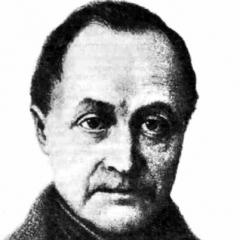
Auguste Comte

Auguste Comte Quotes

Philosopher

Filter quotes by topic

Famous Auguste Comte Quotes

“From the study of the development of human intelligence, in all directions, and through all times, the discovery arises of a great fundamental law, to which it is necessarily subject, and which has a solid foundation of proof, both in the facts of our organization and in our historical experience. The law is this: that each of our leading conceptions -- each branch of our knowledge -- passes successively through three different theoretical conditions: the theological, or fictitious; the metaphysical, or abstract; and the scientific, or positive. In other words, the human mind, by its nature, employs in its progress three methods of philosophizing, the character of which is essentially different, and even radically opposed: namely, the theological method, the metaphysical, and the positive. Hence arise three philosophies, or general systems of conceptions on the aggregate of phenomena, each of which excludes the others. The first is the necessary point of departure of the human understanding, and the third is its fixed and definitive state. The second is merely a state of transition.”

“All good intellects have repeated, since Bacon’s time, that there can be no real knowledge but that which is based on observed facts. This is incontestable, in our present advanced stage; but, if we look back to the primitive stage of human knowledge, we shall see that it must have been otherwise then. If it is true that every theory must be based upon observed facts, it is equally true that facts cannot be observed without the guidance of some theory. Without such guidance, our facts would be desultory and fruitless; we could not retain them: for the most part we could not even perceive them.”

“The mathematical thermology created by Fourier may tempt us to hope that, as he has estimated the temperature of the space in which we move, me may in time ascertain the mean temperature of the heavenly bodies: but I regard this order of facts as for ever excluded from our recognition. We can never learn their internal constitution, nor, in regard to some of them, how heat is absorbed by their atmosphere. We may therefore define Astronomy as the science by which we discover the laws of the geometrical and mechanical phenomena presented by the heavenly bodies.”

“In the final, the positive, state, the mind has given over the vain search after absolute notions, the origin and destination of the universe, and the causes of phenomena, and applies itself to the study of their laws - that is, their invariable relations of succession and resemblance. Reasoning and observation, duly combined, are the means of this knowledge. What is now understood when we speak of an explanation of facts is simply the establishment of a connection between single phenomena and some general facts.”

“The law is this: that each of our leading conceptions-each branch of our knowledge-passes successively through three different theoretical conditions: the Theological, or fictitious: the Metaphysical, or abstract; and the Scientific, or positive.”

“All good intellects have repeated, since Bacon's time, that there can be no real knowledge but that which is based on observed facts. This is incontestable, in our present advanced stage; but, if we look back to the primitive stage of human knowledge, we shall see that it must have been otherwise then. If it is true that every theory must be based upon observed facts; it is equally true that facts can not be observed without the guidance of some theory. Without such guidance, our facts would be desultory and fruitless; we could not retain them: for the most part we could not even perceive them.”

“Language forms a kind of wealth, which all can make use of at once without causing any diminution of the store, and which thus admits a complete community of enjoyment; for all, freely participating in the general treasure, unconsciously aid in its preservation.”

“Every attempt to employ mathematical methods in the study of chemical questions must be considered profoundly irrational and contrary to the spirit of chemistry.... if mathematical analysis should ever hold a prominent place in chemistry -- an aberration which is happily almost impossible -- it would occasion a rapid and widespread degeneration of that science.”