Quotessence
Home / Quotes / Quote by Auguste Comte

Quote by Auguste Comte

Work

Auguste Comte and Positivism: The Essential Writings

The book includes Comte's foundational texts, exploring his views on the scientific method, social progress, and the role of religion in society. It is a comprehensive compilation of his essential writings, providing a detailed look into the development of Positivist thought. more

Author
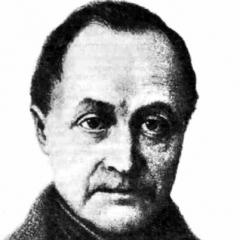
Auguste Comte
Auguste Comte

Auguste Comte, a French philosopher born on January 19, 1798, and died on September 5, 1857, is considered the father of sociology and the founder of positivism. He is best known for his work on the scientific study of society and his creation of the discipline of sociology. His seminal work, 'Cours de philosophie positive,' has had a profound impact on the development of philosophy and the social sciences. more

You May Also Like

“The question whether atoms exist or not... belongs rather to metaphysics. In chemistry we have only to decide whether the assumption of atoms is an hypothesis adapted to the explanation of chemical phenomena... whether a further development of the atomic hypothesis promises to advance our knowledge of the mechanism of chemical phenomena... I rather expect that we shall some day find, for what we now call atoms, a mathematico-mechanical explanation, which will render an account of atomic weight, of atomicity, and of numerous other properties of the so-called atoms.”

“The science and technology which have advanced man safely into space have brought about startling medical advances for man on earth. Out of space research have come new knowledge, techniques and instruments which have enabled some bedridden invalids to walk, the totally deaf to hear, the voiceless to talk, and, in the foreseeable future, may even make it possible for the blind to "see."”

“To seek in the great accumulation of the already-said the text that resembles "in advance" a later text, to ransack history in order to rediscover the play of anticipations or echoes, to go right back to the first seeds or to go forward to the last traces, to reveal in a work its fidelity to tradition or its irreducible uniqueness, to raise or lower its stock of originality, to say that the Port -Royal grammarians invented nothing, or to discover that Cuvier had more predecessors than one thought, these are harmless enough amusements for historians who refuse to grow up.”