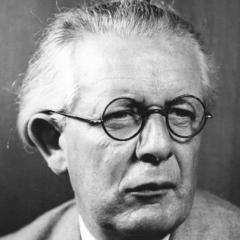
“Every observer has noted that the younger the child, the less sense he has of his own ego. From the intellectual point of view, he does not distinguish between external and internal, subjective and objective. From the point of view of action, he yields to every suggestion, and if he does oppose to other people's wills — a certain negativism which has been called "the spirit of contradiction" — this only points to his real defenselessness against his surroundings. A strong personality can maintain itself without the help of this particular weapon. The adult and the older child have complete power over him. They impose their opinions and their wishes, and the child accepts them without knowing that he does so.” ChildrenWisdomTruthPsychologyJean Piaget Author:Jean Piaget
“I am convinced that there is no sort of boundary between the living and the mental or between the biological and the psychological. From the moment an organism takes account of a previous experience and adapts to a new situation, that very much resembles psychology.” MomentsSituationPsychologyAccountsConvincedBoundariesPsychologicalOrganismsNew Situations Book:Conversations with Jean Piaget Source: Conversations with Jean Piaget
“For the fundamental fact of human psychology is that society, instead of remaining almost entirely inside the individual organism as in the case of animals prompted by their instincts, becomes crystallized almost entirely outside the individuals. In other words, social rules, as Durkheim has so powerfully shown, whether they be linguistic, moral, religious, or legal, etc., cannot be constituted, transmitted or preserved by means of an internal biological heredity, but only through the external pressure exercised by individuals upon each other.” HumansMeanFactsIndividualSocialReligiousAnimalMoralCasesPsychologyPressureFundamentalsInstinctEtcInternalsOrganismsHeredity Book:The Moral Judgement of the Child Source: The Moral Judgement of the Child
“Much research in psychology has been more concerned with how large groups of people behave than about the particular ways in which each individual person thinks... too statistical. I find this disappointing because, in my view of the history of psychology, far more was learned, for example, when Jean Piaget spent several years observing the ways that three children developed, or when Sigmund Freud took several years to examine the thinking of a rather small number of patients.” PeopleThinkingWayYearsChildrenPersonsHas BeensThreeIndividualViewsNumbersPsychologyGroupsExampleParticularResearchConcernedPatientBehaveObservingDisappointingSmall NumbersLarge Groups Author:Jean Piaget
“It is with children that we have the best chance of studying the development of logical knowledge, mathematical knowledge, physical knowledge, and so forth.” InspirationalChildrenChanceEducationStudyPsychologyDevelopmentMathematicalLogicalEpistemologyChild Development Book:Dialogue with Jean Piaget Source: Dialogue with Jean Piaget
“Logical positivists have never taken psychology into account in their epistemology, but they affirm that logical beings and mathematical beings are nothing but linguistic structures.” TakenPsychologyAccountsStructureMathematicalLogicalLinguisticsEpistemology Author:Jean Piaget
“Our problem, from the point of view of psychology and from the point of view of genetic epistemology, is to explain how the transition is made from a lower level of knowledge to a level that is judged to be higher.” MadeProblemLevelsViewsPsychologyHigherPoint Of ViewTransitionJudgedEpistemology Author:Jean Piaget
“In genetic epistemology, as in developmental psychology, too, there is never an absolute beginning.” PsychologyAbsolutesEpistemologyDevelopmental Author:Jean Piaget