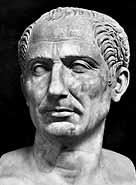
Julius Caesar, born in 100 BC, was a prominent Roman statesman, military leader, and writer. Known for his exceptional military skills and reformist spirit, he became a significant figure in the late Roman Republic. Caesar implemented a series of reforms to strengthen central authority and achieved remarkable military victories, such as the conquest of Gaul and the defeat of Pompey. However, his ambition for power ultimately led to his assassination, ending the Roman Republic and marking the beginning of the Roman Empire era.
Related Quotes
Source: "Bellum Britannicum", De bello Gallico, IV. 20-30, V. 8-23; 1881 [Leather Bound]
“Postremo quid esse levius aut turpius, quam auctore hoste de summis rebus capere consilium?”
Source: The Conquest of Gaul
“Wine and other luxuries have a tendency to enervate the mind and make men less brave in battle.”
“To win by strategy is no less the role of a general than to win by arms.”
“Every woman's man, and every man's woman.”
Source: Delphi Complete Works of Julius Caesar (Illustrated)
“In extreme danger fear feels no pity. [Lat., In summo periculo timor miericordiam non recipit.]”
“Avoid an unusual and unfamiliar word just as you would a reef.”
“Men's minds tend to fear more keenly those things that are absent.”
“I believe that the members of my family must be as free from suspicion as from actual crime.”
“If I fail it is only because I have too much pride and ambition.”
“A coward dies a thousand deaths, the gallant never taste of death but once.”
“In the end, it is impossible not to become what others believe you are.”
“The greatest enemy will hide in the last place you would ever look.”
“It is better to create than to learn! Creating is the essence of life.”
“As a rule, men worry more about what they can't see than about what they can.”
“No one is so brave that he is not disturbed by something unexpected.”
“If you must break the law, do it to seize power: in all other cases observe it.”
“What we wish, we readily believe, and what we ourselves think, we imagine others think also.”
“Men in general are quick to believe that which they wish to be true.”
“It is not these well-fed long-haired men that I fear, but the pale and the hungry-looking.”
“I have lived long enough both in years and in accomplishments.”
“In war, events of importance are the result of trivial causes.”