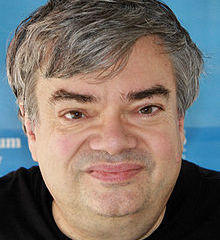
“Blogging has mostly been an opportunity to react more immediately to experiences to try out ideas that I may end up using in the print media or in some other place. When I write books, it's a way for me to bring readers into the experience of writing the book, all through the process of writing the books that I write. I talk about what I'm up to in the blog. I let people know what I am doing. To me, it's just part of putting my professional life up in a way that people who are interested in it can access; and learning things from them as well.” PeopleWritingTryingBookOpportunityPrint Author:Terry Teachout
“That's something you can't get off the wires in New York is people providing intelligent coverage of what your theater company in Podunk is up to. Many of the people who write what we call amateur criticism are professionals in anything other than name and receiving a paycheck. Very often, they know more than the professional critic who might be writing for their local newspaper. So, really, I'm all for it. It's changing the playing field, it's shaking things up, it's going to make the critical environment a healthier environment.” PeopleWritingEnvironmentCriticismIntelligentCriticsWireShaking Author:Terry Teachout
“I'm especially interested in what I call practitioner criticism, which is when people who practice an art form start writing about it on blogs. I think that's an immensely important development. I want to see much, much more of that. People who make music who are verbally articulate. And not all musicians are verbally articulate. But those who are should be encouraged to write about what they do and their perception of what other people do. It makes the discourse smarter.” PeopleThinkingWritingArtImportantPerceptionMusicianCriticismBe Encouraged Author:Terry Teachout
“I had a checklist in my mind of the things that make a biography practical. Is the source material centralized? Is it easy to find? Are there new primary sources that no one has ever had access to? Are all the sources in English? If they're not, are they in a language that you speak? And I realized that not only is Armstrong the most important figure of Jazz in the 20th Century, but he's a perfect subject for a biography for all of these reasons. I had always loved his music and I had been fascinated in him as a personality. And that's really the key to writing a biography.” WritingMindImportantReasonSpeakLanguageEasyPerfectPersonalityJazzI Realized20th CenturyPrimary Source Author:Terry Teachout
“I've always loved opera; it never occurred to me that I would write a proper libretto. One of my closest friends is a composer, Paul Moravec, and a few years ago, Paul and I were at lunch, and I said to him, "you really have to write an opera." So, he says very casually to me, "I'll do it if you write the libretto." Well, little did I know that the within a couple of years we would end up getting a commission from the Santa Fe Opera to write an opera together, "The Letter," which turned out to be the most successful commissioned opera in the history of the Santa Fe Opera.” WritingTogetherSuccessfulCoupleComposer Author:Terry Teachout
“The most important thing to remember is that the composer is a senior partner. You cannot force a subject on a composer if it doesn't inspire him. He has to take the lead, you are an enabler, and you are creating the enabling conditions under which he can write great music. Your words are secondary. Many librettists in opera collaborations in the past have forgotten this, or not known it, or refuse to accept it and tried to get out in front of the creative process and it just doesn't work that way.” WritingImportantPastRememberAcceptingCreativeInspireForgottenCollaborationComposerCreative ProcessSeniorGreat Music Author:Terry Teachout
“There will be this mix of people like me who write for major national newspapers and amateur critics, practitioner critics, whose primary way of distributing what they talk about is through blogs and on the web. The line between professional and amateur criticism will become increasingly blurred. The problem here is that if you want to do this for a living, you have to be able to earn a living doing it.” PeopleWritingProblemCriticismCritics Author:Terry Teachout
“I wouldn't care to speculate about what it is in Westlake's psyche that makes him so good at writing about Parker, much less what it is that makes me like the Parker novels so much. Suffice it to say that Stark/Westlake is the cleanest of all noir novelists, a styleless stylist who gets to the point with stupendous economy, hustling you down the path of plot so briskly that you have to read his books a second time to appreciate the elegance and sober wit with which they are written.” WritingBookCareNovelEconomyPathWrittenAppreciateWitNovelistsPlotSoberEleganceHustleStarksNoirStylist Author:Terry Teachout